Only a short train journey to the
northwest of Spain’s capital city, Madrid, is the ancient town of Segovia. Perfectly
situated for a day’s outing from the capital, or an overnight trip if you have
the time, Segovia is well worth a visit. The town is relatively small and very
picturesque, boasting some wonderful architecture and is set in the beautiful
surroundings of the plains of old Castille. Segovia was first settled at least
as far back as the Iberian Celtic Iron Age, but it is perhaps best known
nowadays for its Roman aqueduct. One of the most remarkable pieces of Roman
architecture still extant – and, perhaps more amazingly, still in use – today.
I visited Segovia back in May 2010, when I was in staying in Madrid, working on
an exhibition at the Arte Canal Exhibition Center, near Plaza Castilla, which
appropriately enough is housed inside a converted nineteenth-century reservoir,
the interior of which still contains the elegant brick arches that used to hold
up the roof.
The Roman aqueduct, or ‘El Puente’ –
‘the bridge’, as it is known locally in Segovia, is certainly an impressive
feat of architecture – built in the late first or early second century AD, possibly
around the time of the Emperor Trajan (reigned 98–117), it covers a distance of
almost 700 metres, and changes direction several times in its course. An
initial single course of 75 arches transfers to a second course of 44 double
arches, reaching a maximum elevation of 29 metres above the valley floor. It’s
a remarkably elegant structure, built of granite blocks quarried from the
nearby Sierra de Guadarrama mountains, which have been fitted together without
the aid of mortar. The aqueduct structure itself is the terminus of an equally
remarkable piece of hydraulic engineering. Unlike a lot of Roman municipal
watercourses, which favoured water drawn from the cleaner sources of natural
springs, the aqueduct at Segovia is fed by the River Aceveda, from the
headwaters of the River Frio, in the pine and oak forested slopes of the
mountains. This meant that along its course the aqueduct incorporated a system
of basins which were used to filter out silt, sand and organic debris which
might otherwise contaminate or block the water-flow.
In total, from its source
to its terminus in the city’s Alcazar, the system traverses some 15 kms – all
propelled by the natural gradients of the landscape and gravity, and,
effectively maintained as a working system from its construction to the present
day, it is indeed a remarkable feat of human ingenuity and practical
engineering. Overlooking this particular continuity and its amazing longevity,
I have a 1920s guidebook which somewhat fancifully, and rather disparagingly,
claims that: “the ignorant populace [of
old Segovia] wondering how or why those
huge arches spanning the valley had ever been erected, and unable to find a
satisfactory answer, promptly attributed its construction to Satan, and called
it the ‘Bridge of the Devil’ – a name by which it is popularly known to this
day.” – El Puente is certainly a remarkable survival from pagan times to
the present, but given that it served a communally beneficial function I’m sure
the locals thought it a case of ‘better the devil you know’ than letting
superstition spite themselves by cutting off their own water supply.
The old town of Segovia also
contains some notable buildings from later historical eras, all bearing the
marks of the town’s uses and abuses right up to the recent Spanish Civil War in
the 1930s. Located on the old pilgrim route of the Camino de Santiago from
Madrid, Segovia was notably the place where Isabella I was proclaimed Queen of
Castile and Leon in 1474 in the Church of San Miguel de Segovia. Her marriage
to Ferdinand II of Aragon five years earlier effectively unified Spain under
the twin dynasties, although she is perhaps best remembered for the fact that
the ‘Reconquista’, expelling the last of the Moorish rulers from Spain, was
completed during her and Ferdinand’s joint reign; however, this too is possibly
eclipsed by her and her husband having famously supported the first voyage of
Christopher Columbus to the New World in 1492. She is undoubtedly an important
figure in the history of Spain. Isabella and her husband, Ferdinand, are both
buried next to Granada’s Cathedral in the Capilla Real (see here).
The Alcazar, or Fortress, of
Segovia is one of the most impressive castles in Spain. Looking rather like the
iconic cartoon castle of a Disney Princess, with its conical roofed towers and its
formidable central bastion, it stands on a rocky prominence jutting out over
the landscape below, commanding some wonderful scenic views. Its foundations go
back as far as the Roman era, but the present structure, which largely dates
from the medieval period although having been much adapted over time, has
served as a Royal Palace, a military stronghold and college. It retains its
military association today as the Museum of the Royal College of Artillery.
Many of its rooms are splendidly decorated and it houses all manner of historical
weapons, ordinance, suits of armour, and standards. It is a fascinating place
to wander around, but an interesting unflagged modern-day military aside from
all the medieval armoury dotted about the place can be found on the battlements
of the roof, where many of the stones have been inscribed with graffiti by
soldiers who fought on the Republican side during the Spanish Civil War in the
1930s – looking over the names scratched into the stonework you will find many of
foreign origin, from the International Brigades, including fighters from
Britain, who had signed up to fight for the anti-fascist cause.
From 31 May to
6 June 1937 the ‘Segovia Offensive’ was fought here in an attempt to hold back
the nationalist forces from their advance towards Bilbao, but the offensive ultimately
failed due to the nationalists’ air superiority. This battle is perhaps most
notably memorialised in Ernest Hemingway’s semi-fictional account of it in his
novel, For Whom the Bell Tolls (1940)
– which takes its title from a meditation upon the nature of death written by
the Old English poet, John Donne; the sentiment of which at the time rang with
an apposite sense of truth given all the anxious uncertainties posed by an existentially
threatened future and its call for a greater sense of unity in a time of genuine
adversity. Looking at those long forgotten names scratched upon the battlements
of the Alcazar, it is a passage which we’d perhaps do well to remember,
especially now that the devil of the extreme far-right is once again knocking
at Europe’s door:
No man is an island entire of itself; every man
is a piece of the continent, a part of the main;
if a clod be washed away by the sea, Europe
is the less, as well as if a promontory were, as
well as any manner of thy friends or of thine
own were; any man's death diminishes me,
because I am involved in mankind.
And therefore never send to know for whom
the bell tolls; it tolls for thee.
San Martin Church, Segovia
Segovia Cathedral
Church of San Miguel de Segovia
The Alcazar, Segovia
Spanish Civil War era graffiti on the roof of the Alcazar
“An
abundant supply of water, brought from the mountains by old Moorish aqueducts,
circulates throughout the palace, supplying its baths and fish-pools, sparkling
in jets within its halls or murmuring in channels along the marble pavements.
When it has paid its tribute to the royal pile and visited its gardens and
pastures, it flows down the long avenue leading to the city, tinkling in rills,
gushing in fountains and maintaining a perpetual verdure in those groves that
embower and beautify the whole hill of the Alhambra.”
Climbing that “long avenue” on foot
under the leafy, green shade of the tall trees and the dense thicket of shrubs
on either side of the path, halfway up you come across a bronze statue whose
patina of verdigris echoes its verdant surroundings. This statue is the
likeness of the man who wrote those words – the American writer and diplomat, Washington
Irving.
Perhaps best known as the author of
Rip Van Winkle (1819) and The Legend of Sleepy Hollow (1820), Washington
Irving lived for a time in 1828 in the ruined palace of the Alhambra. At the
time he was researching and writing a history of Granada, but it was his word-sketches
of his time at the Alhambra – which he later collated with retellings of
various myths, stories and historic episodes in a book, Tales of the Alhambra (1832), that have best stood the test of time.
The book is a classic in a lost genre of what we might characterise as
‘romantic history’ – part memoir, part travelogue, part history and even
ethnography – Tales of the Alhambra is essentially a kaleidoscopic work
which encapsulates everything about the Alhambra that so enchanted Irving. It
is still hugely popular today, especially in Granada where it is available in
the town’s many souvenir shops, translated into multiple different languages.
It’s pages convey a wonderfully atmospheric sense of what it might have been
like to live an idle life amidst the formerly-dilapidated old pile, haunting
the towers, galleries and gardens; looking out across the town of Granada from its
balconies and dreaming of the Moorish myths which still enchanted the place and
which were clearly foremost in Irving’s mind. This is history as romantic reverie
par excellence.
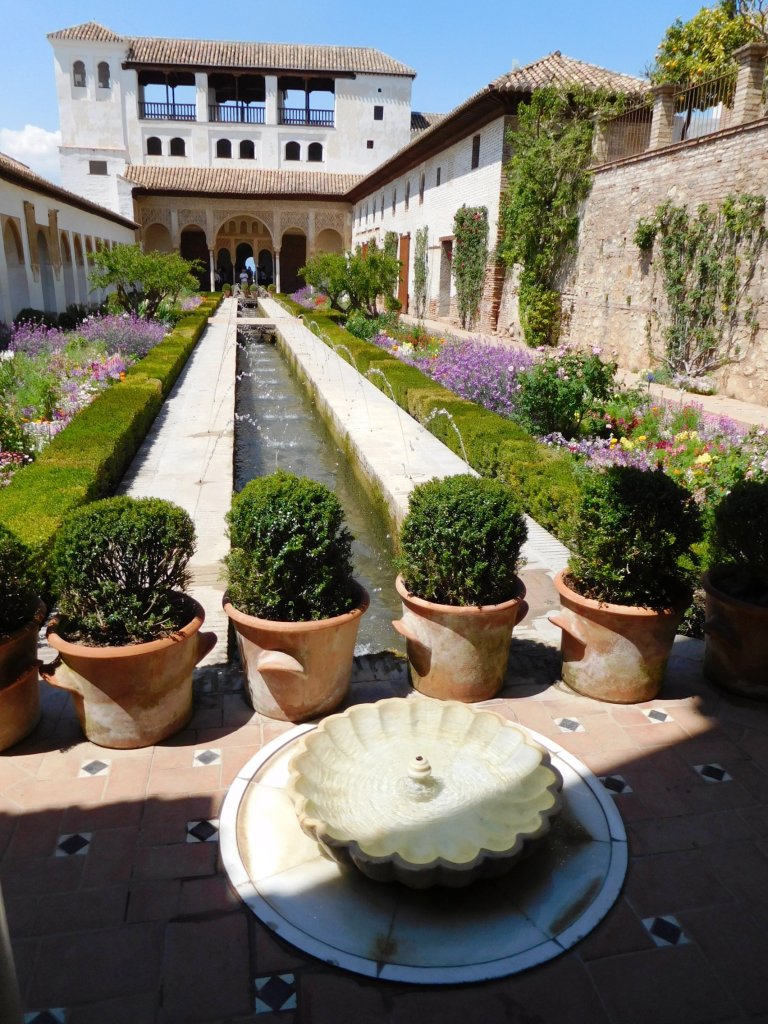
And rightly so, in many ways. I
defy anyone who visits the Alhambra today not to be touched by the same sense
of romanticism which enchanted Irving. It is perhaps all due to the combination
of sun-scorched stone and pink terracotta, along with the lush greenery of the
gardens, the beautiful, interlocking geometric patterns adorning the
architecture, and the gorgeous tonal harmonies of its myriad polychrome tiles.
Wandering through its cool arcades with their smooth white marble floors,
besides the burbling water of the many fountains dotted throughout its ornate
courtyards. Orange trees seemingly everywhere, along with the drowsy scent of
its flower gardens gently pervading throughout. It is all so beguilingly
beautiful.
I’d long wanted to visit Granada
and the Alhambra in particular. I’ve been on many trips to many places previously
in Spain, but this was my first trip that wasn’t for work. The Alhambra, which
literally means ‘the red one’, was a combined palace and fortress – built on
Roman foundations, it was constructed and embellished from the mid-13th
century onwards as the seat of the Nasrid Emirate of Granada (1248-1492).
Contemporary Moorish poets described the Alhambra as “a pearl amidst emeralds” referring to the imposing white edifice
emerging from the verdure of its hilltop eminence, surrounded by tall green trees.
After a time, as a tributary of the Kingdom of Castile, diplomatic relations
between the Nasrids and the Castilians broke down irreparably. The centuries
long Spanish Christian ‘Reconquista’, which culminated in the late fifteenth
century, eventually saw the Nasrid Muslim rulers expelled from Spain, pushing
them back to the shores of North Africa. Muhammid XII, better known by
Europeans as Boabdil, the last Sultan of Granada, reluctantly departed Spain in
1493, sailing south across the Mediterranean into exile in Morocco. The palace
was then used for a time by the Christian Spanish monarchy, who added to its
buildings before the site was eventually abandoned to the depredations of time
and neglect, slowly becoming the picturesque ruin which Washington Irving seemingly
stumbled upon in 1828.
Hall of the Abencerrajes - David Roberts
He was later followed by other
romantic artists, such as the painters John Frederick Lewis and David Roberts,
both perhaps now better remembered for their works depicting the ruins of
Ancient Egypt and the Near East, yet it was here at the Alhambra that they each
first encountered the exotic lure of the East. But it was this romantic,
orientalising tendency which also lured them time and again to exaggerate and
embellish their representations of these ruins of bygone Moorish glories.
Roberts’ depictions characteristically diminish the scale of the people within
his works, thereby elevating the dimensions of the Alhambra’s architecture to
proportions more appropriate to the grandeur of European Gothic Cathedrals,
perhaps in order to accentuate the suggested architectural and stylistic affinities between
the two. Similarly, Irving’s writings tend to accentuate the picturesque by
sparsely populating the Alhambra, reshaping the more likely reality around him
in order to emphasise and embroider the solitary communion of his
self-reflections with the fabric of the building and the forgotten layers of
its past, giving his text a more intimate and individualistic sense of
personal, almost clairvoyant connection. As he wrote to a friend at the time: “Here then, I am nestled in one of the most
remarkable, romantic and delicious spots in the world. I breakfast in the
Saloon of the Ambassadors, among the flowers and fountains of the Court of the
Lions, and when I am not occupied with my pen I lounge with my book about these
oriental apartments, or stroll about the courts, and gardens, and arcades, by
day or night, with no one to interrupt me. It absolutely appears to me like a
dream, or as if I am spell-bound in some fairy palace.” Each visitor it
seems perceives the place through eyes acutely adjusted to his own ends.
Court of the Lions - engraving after David Roberts
Nowadays the Alhambra is the main
tourist attraction in Granada and the reason many people are drawn to visit the
town. We visited in early May when the weather was warm but not yet too hot. Staying
at the foot of the Alhambra hill in a small courtyard house which had been
converted from an old Moorish villa, we were given a room with a polished
terracotta floor and a wonderful view overlooking the small stream, known as the
River Darro, which runs down the side of the hill between the Alhambra, which
towered overhead, and the similarly old and picturesque part of the town, known
as Albaicín. Here you can happily spend hours wandering the winding cobbled
streets admiring the architecture, finding wonderful, quiet hidden vistas giving beautiful views of the city and, of course, the Alhambra.
Granada Cathedral
Scholar's graffiti, Granada Cathedral
A couple of blocks further along,
hidden in the labyrinthine backstreets of what was once the old Muslim Medina,
is Granada’s Cathedral and the Royal Chapel, which contains the tombs of King
Ferdinand II of Aragon and Queen Isabella I of Castile, whose marriage in 1469
effectively unified Spain. Ferdinand and Isabella are perhaps best remembered
today for financing the first transatlantic voyage of Christopher Columbus in
1492. If you circumnavigate the Cathedral and Royal Chapel’s tall, imposing
walls you will notice large faded red letters in certain places, often set high
above your eyeline – these are old graffiti, said to be painted using bull’s blood;
they were made by the scholars of Granada’s university in the sixteenth century
to celebrate success in their exams.
The interior of the Cathedral is an
impressive sight, not least for the sheer height of its large internal spaces,
but also for its many architectural decorations, frescoes, and other works of
art. The characteristic style of its Renaissance-era architecture, following classical
Vitruvian principles in the Corinthian order, is a complete contrast to the
Alhambra. Where the halls and galleries of the Alhambra achieve a pleasant
balance of warmth and coolness, the grey smooth stone surfaces and small windows
set far above the ground makes some parts of the Cathedral feel distinctly
cold, dark and sepulchral. However, happily it can provide a welcome refuge
from the fierce heat of the midday Spanish sun, but still beware –
contemplating the divine too long in such surroundings can be apt to leave you
feeling rather like a tiny frog trapped in well, unavoidably aware of your
mortal insignificance whilst staring up at the unreachable divine light
rippling far above your head.
Granada Cathedral
There is much to see at the
Alhambra. Some of it is freely open to all and can be wandered into and around
at leisure, but the main buildings and gardens require a ticket (which due to
the high demand each day definitely needs to be booked well in advance of your
arrival). We set aside a whole day to visit the main parts of the Alhambra,
following the sage advice of a Spanish friend of mine in order to plan the best
sequence in which to explore. Starting with the oldest part of the site, the
Alcazaba, or Citadel, in the cool air of the morning. We’d booked our timed entry tickets for around
noon to enter the Plaza de Nazaríes, the ‘Royal Complex’ – which includes the
Court of the Myrtles, the Hall of the Ambassadors, the Court of the Lions, and
the Hall of the Abencerrajes (named after a prominent Zasrid noble family, whom
legend says were all assassinated in this hall). This took us a good couple of
hours to explore, and meant we escaped the midday sun, leaving us with the
remainder of the day to stroll at leisure through the palace gardens. Finally
making our way up to the Generalife, the name derived from the Arabic ‘Jennat
al Arif’, meaning the ‘Garden of Arif’, or the ‘Garden of the Architect’ in the drowsy warmth of
late afternoon.
"Celinda!"
As Irving himself said, “How
unworthy is my scribbling of the place.” It is hard to put into words the
thoughts and feelings this wonderful old palace inspires (although Irving did a
pretty damn good job of it in his famous book!), especially in the moments when
the coach parties of tourists bustle out of your immediate vicinity and you are
left in a peaceful moment of isolation before the next wave bustles in. Out in
the gardens there’s a lot more room to circulate and find more tranquil and
secluded spots in which to reflect and unhurriedly take it all in. The gardens
were filled with a gorgeous array of flowering plants and orange trees in full
fruit at the time we visited. At several places in the gardens (and around the
town too) we came across the split skins of some of the oranges which it
appeared people were clearly all too strongly tempted to taste – yet, watching
the reactions of people actually doing this, and given the fact that most of
the fruit was frequently left behind with the skins, it seemed to suggest that these
oranges had a bitterness best reserved for making Seville marmalade! –
Everywhere we wandered throughout the Alhambra’s grounds we could smell all
around us the lovely scent of what we took to be orange blossom, given the
number of orange trees; but, on our eventually tracking down its source to a small
and unobtrusive looking white flower, a passing gardener who worked in the
grounds of the Alhambra saw our delight in discovering the tiny blossoms and
stopped to tell us the flower’s Spanish name, “Celinda!” – One day,
we thought, we’d love to see if it might be possible to grow celinda (sweet
mock-orange, Philadelphus coronarius L.)
in our own garden in Japan – to bring back memories of the Alhambra on warm
summer nights.
Manuel de Falla in his home on Alhambra Hill
Despite his faux personal
misgivings, Washington Irving’s ‘unworthy scribblings’ have proved to be a
lasting literary monument to the captivating charm of the Alhambra. Describing
it as a unique folly to a bygone age of Moorish architectural magnificence: “Perhaps
there never was a monument more characteristic of an age and people than the
Alhambra; a rugged fortress without, a voluptuous palace within; war frowning
from its battlements; poetry breathing throughout the fairy architecture of its
halls.” His words still resonate strongly with today’s visitors, but there
is a similar monument to the Alhambra in a different medium which was penned
some eighty years later by the Spanish composer, Manuel de Falla in 1915. Nights
in the Gardens of Spain is an evocative soundscape, which to my ear evokes
the fluid sounds of shallow rills of water and old bronze-spouted fountains
tinkling in the polished marble courtyards and the lush green gardens of the
Alhambra. Falla first visited Granada in 1915 and was so taken by the place
that he later moved there. Settling in a very simple house, just a short stroll
from the entrance to the Generalife, where he lived from 1921 to 1939. His home
has been preserved and can be visited today. Falla referred to this magical
piece of music as ‘symphonic impressions.’ The gentle flutes, oboes and
bassoons, and the softly plucked strings syncopate with the tinkling piano and
rhythmic timpani in passages which are reminiscent of Sufi dances, a mystical
kind of meditation famously performed by whirling dervishes, lending the music
an exotic, orientalist air which in parts puts me in mind of snake charmers or
the vintage classic Hollywood film, Casablanca (1942), starring Humphrey Bogart and Ingrid Bergman.
Manuel de Falla, second from left
Later on, the graphic artist M. C.
Escher visited the Alhambra in 1936, shortly before the Spanish Civil War. He
was greatly interested in the repeating geometric motifs which appear to be
interlocked in patterns that repeat into infinity in the ornate coloured tiles and intricate plasterwork which decorate
many of the palace’s finest rooms. These mathematical patterns in which lines simultaneously
delineate both inside and outside spaces, blurring the transitions between the
two to create mind-bending optical illusions can be found echoed in many of his
best known drawings.
In many ways, since it was
abandoned by the Moors, who presumably knew all its secrets, the Alhambra has
become an illusion, the fascination of which continues to endure even to this
day. Again, Washington Irving perhaps says it best: “The peculiar charm of this old dreamy palace is its power of calling
up vague reveries and picturings of the past, and thus clothing naked realities
with the illusions of the memory and the imagination.” Just as it was for
Irving, so too I found myself falling utterly under the spell of the Alhambra.
Reflecting upon the place now, I realise that all the elements of it – in terms
of its architectural form, its garden design, and in terms of the inspiration
it gave to both contemporary and later literary, artistic and musical tributes
– the Alhambra appeals to the full range of my aesthetic inclinations. For me,
its harmonies satisfy the self’s primary senses in terms of sight, scent, sound,
textures – and even, perhaps more surprisingly, taste. One of the main reasons
why I so enjoy travelling in Spain is its Mediterranean cuisine. All of the
things I relish the most seem to be combined in Spanish tapas: cheese, olives,
pimentos, white tuna fish, chorizo, and, of course, iberico ham. Riojas are one
of my most favourite wines, but by far one of my best loved tipples is Spanish
brandy. It’s made in the Jerez region of Andalusia, and the distillation
techniques used to produce this brandy are said to have been passed down through
the local generations from the Moors, who settled in Jerez de la Frontera,
roughly 160 miles west of Granada, around 711. Spanish brandy gets its
distinctive flavour, like burnt sugar or molasses, partly from the fact that it
is matured in old sherry barrels. Hence the best way to end our day ambling
around the Alhambra was to sit on the terrace of the Restaurante Especia, part
of the idyllic Parador de Granada Hotel, overlooking the archaeological remains
of the Turkish bath of the old Moorish palace, enjoying the scenic view of
Sacromonte and Albaicín on the opposite hillside, whilst enjoying a very late
lunch … drifting into an early dinner. Here I could easily empathise with the
old Nasrid sultans and their bards, and happily believe that if heaven is indeed
a paradise, that paradise is certainly echoed in the gentle, earthly breezes
stirring the leafy green shade of the beautiful, sun-kissed gardens of old
Spain.
Granada's Modern Day Medina
River Darro
Iglesia San Gil y Santa Ana
Gracias por sua visita
~
References
Michael Jacobs, Alhambra (Frances Lincoln, 2005)
Yuja Wang | Charles Dutoit | NHK Symphony Orchestra


 In total, from its source
to its terminus in the city’s Alcazar, the system traverses some 15 kms – all
propelled by the natural gradients of the landscape and gravity, and,
effectively maintained as a working system from its construction to the present
day, it is indeed a remarkable feat of human ingenuity and practical
engineering. Overlooking this particular continuity and its amazing longevity,
I have a 1920s guidebook which somewhat fancifully, and rather disparagingly,
claims that: “the ignorant populace [of
old Segovia] wondering how or why those
huge arches spanning the valley had ever been erected, and unable to find a
satisfactory answer, promptly attributed its construction to Satan, and called
it the ‘Bridge of the Devil’ – a name by which it is popularly known to this
day.” – El Puente is certainly a remarkable survival from pagan times to
the present, but given that it served a communally beneficial function I’m sure
the locals thought it a case of ‘better the devil you know’ than letting
superstition spite themselves by cutting off their own water supply.
In total, from its source
to its terminus in the city’s Alcazar, the system traverses some 15 kms – all
propelled by the natural gradients of the landscape and gravity, and,
effectively maintained as a working system from its construction to the present
day, it is indeed a remarkable feat of human ingenuity and practical
engineering. Overlooking this particular continuity and its amazing longevity,
I have a 1920s guidebook which somewhat fancifully, and rather disparagingly,
claims that: “the ignorant populace [of
old Segovia] wondering how or why those
huge arches spanning the valley had ever been erected, and unable to find a
satisfactory answer, promptly attributed its construction to Satan, and called
it the ‘Bridge of the Devil’ – a name by which it is popularly known to this
day.” – El Puente is certainly a remarkable survival from pagan times to
the present, but given that it served a communally beneficial function I’m sure
the locals thought it a case of ‘better the devil you know’ than letting
superstition spite themselves by cutting off their own water supply.