14 October 2018

'Colonial Loot' & Modern Museums


https://www.theguardian.com/culture/2018/oct/12/collected-histories-not-everything-was-looted-british-museum-defends-collections?CMP=share_btn_tw


This is something which has been bugging me for a while now. The question of colonial loot and museums. It is a question which features in our newspapers, TV and social media with increasing frequency these days. Its prominence began with the rise of the ‘Rhodes must fall’ movement in South Africa. It is an issue which primarily a rising younger generation is promoting to our wider social consciousness. I have worked in the museum sector for over twenty years and I’ve seen the slow rise of this consciousness coming to the fore and it has a lot to do with this generational shift. 

https://www.theguardian.com/culture/2018/oct/12/collected-histories-not-everything-was-looted-british-museum-defends-collections?CMP=share_btn_tw
Click on the image above to read the full article


When I began work in this sector the museum where I work was still very hierarchical, still run according to old and seemingly long established Civil Service rules. Junior staff were expected to be deferential to their senior colleagues in a far more rigid and inflexible way than they are nowadays. Over the years I’ve watched this mindset relaxing itself. There are still elements of the old school, the Museum Director is still king (and more often than not, still a man), but we no longer have to doff our caps and be mindful of using the appropriate honorifics of our heads of department in quite the same way as we used to. Academia has been democratised. I’m now witnessing both my contemporary and my junior colleagues (i.e. – those younger than me, who have graduated or got their PhDs long after I myself graduated) rising to the positions of senior curators and even heads of department. And with this transition of one generation succeeding the one before, change is inevitable. It may seem like traditions are falling by the way, but as any anthropologist knows all traditions evolve. Culture isn’t static. Hence formal colonialism is no longer an active foreign policy, at least not on the broad blanket scale that it used to be. But that colonialism which went before is undoubtedly the foundation of our current world system. Globalisation began with colonialism. Without it we probably wouldn’t have the kind of trade deals we have today, nor global institutions such as the World Bank, The World Trade Organisation, The United Nations, etc. In many parts of the world the social and geographical concept of the modern nation state was an idea in and of itself which was exported with the imposition of empire on other parts of the globe, later taken up by the resistance movements which eventually succeeded in gaining independence for those peoples who had been colonised.

https://www.theguardian.com/culture/2018/oct/12/collected-histories-not-everything-was-looted-british-museum-defends-collections?CMP=share_btn_tw
Click on the image above to read the full article


Colonial expansion in the modern era (i.e. – from the late 1600s onwards) was a big project which spanned several centuries. It was not always a coherent project however. It often evolved as an ad hoc, contingent and improvised thing. In some places where colonialism took hold it set down roots and grew, in some places it managed to cling on for a while before either fading away or being fought off (think of India, the republics of Latin America, the old Ottoman domains), or in some places it managed to reshape the entire region and so morphed into something entirely its own (think of Singapore, the USA, Australia). It wasn’t always invading armies which set the process in motion either. Independent traders were often the first to make contact with other cultures (for instance, it’s been suggested that European whaling ships may well have reached many of the Pacific islands and Australia before Captain Cook), and these first contacts could often be mutually profitable, but as with any kind of social interaction disagreements, disputes, instances of fraud (real or perceived) could lead to conflict and the desire for restitution. Hence the next European to reach a particular Pacific island might unwittingly reap the knock on effect (quite literally) of his unknown predecessor’s wrong actions and thereby find himself koshed on the head, or alternatively he might be welcomed wholeheartedly had the last European visitor been more benign. In the case of the former situation such a ‘tit for tat’ might well have escalated out of proportion if a European gunboat was dispatched to ‘teach the natives a lesson.’ In the case of the latter, a trading post might thereby be established which then evolved over time into one of today’s major trading cities. All such interactions however involved the exchange of things and this for me, as an academic researcher, is the crux of the ‘colonial loot’ debate.

https://www.rt.com/news/441183-british-museum-stolen-artefacts/
Click on the image above to read the full article


I say ‘debate’ – but is it really a debate? … Many of the news media articles currently appearing on this topic highlight an increasingly black and white view of the past. Undoubtedly some aspects of the past can be read in such terms. It is impossible to countenance the Amritsar massacre or the Holocaust as anything but unquestionably bad. But other historical incidents and individuals constitute more of a grey area. Take Cecil Rhodes for example. He might not have been a particularly nice character, but should he (or the lingering evidence of the sway he once held over our societies), like Isambard Kingdom Brunel’s cigar, be airbrushed from our history? – Part of the calls made by the ‘Rhodes must fall’ campaign is that it is time for the public statues of Rhodes to be moved from the centre of our towns and institutions into our museums as a way of making things historical history. 

Some of the responses to the Guardian headline posted on Twitter


Museums are good repositories for this kind of baggage. By putting Rhodes’s statue in a museum we can categorise it, label it, explain who he was, why a statue of him was made, and why it stood for so long where it did, as well as why it was high time for it to be moved, re-contextualised, re-thought, and re-positioned. But what then of all the other things already in museums? Museums have long been the repositories of colonial knowledge, as colonial institutions themselves they are often freighted with just such baggage of their own. The British Museum being a straw man par excellence of this kind. Even its name – British rather than World or Global – deeply rankles some people. There are now increasing calls to ‘decolonise our museums.’ Hollywood recently highlighted this in what will probably come to be seen as an iconic cultural moment in cinema – the scene in which an African colonial-era descendent questions the legitimacy of a present day European curator’s assumption of custodianship of the past in the Marvel comics blockbuster, Black Panther (2018).


This is a debate which in many ways is only just beginning. And I for one feel that the media acting as a catalyst are very much goading this movement to run before it can properly walk. In saying so, as a museum professional, I don’t mean to be defensive. In some ways I think this is a good thing and long overdue at that. And I have certainly noticed these issues coming to the fore very rapidly in the curatorial forums I’ve attended more recently within the museum in which I work as well as at study days, conferences, and exhibitions which I’ve attended at other museums and universities over the last few years. The hidden stories behind museum objects – the history of collecting – is definitely coming to the fore. For many years I have been fascinated by this hidden history. One of the first things I ever did when I began working in the museum was to leaf through the departments' catalogues with the question at the forefront of my mind as to how did this object arrive in the museum? Not just who found it, but also how was it bought, dug up, found, discovered, traded, inherited, donated, acquired, deposited? – All of these words add layers of nuance to an object’s history. They can alter its meaning and its value, both symbolically as well as financially. Provenance is key to museum work.

Label in the British Museum (Room 33) describing the 'forcible' taking of objects during the British Invasion of Tibet in 1904

Some of the responses to the Guardian headline posted on Twitter


Without a provenance an object can only tell us so much about the past – a good provenance (i.e. – not just knowing where it came from, but how it was acquired and by whom, etc.) can reveal a wealth of information which simply seeing and recognising what the object is won’t do on its own. But here too can arise the post-colonial complications which the decolonise museums movement tend to gloss over. ‘All colonialism and its effects are bad’ is a black and white view which negates the nuances of how the world actually worked and functioned under colonialism. Everyone within the colonial world (both coloniser and colonised) was making his or her way through that system within the parameters which colonialism laid down around them. They negotiated their world just as we negotiate ours. Individuals travelling within the bounds of empire bought, traded, and collected – interacting with one another just as we do today. If you go on holiday and buy a tourist souvenir are you exploiting or ‘culturally appropriating’ any more from the local population than someone who similarly travelled within the British Empire and bought souvenirs 100 or 200 years ago? – If you slip that piece of tourist tat into your bag and manage to leave the shop undetected, not having paid for it, you most definitely are – hence the analogy of objects ‘collected’ from the sacking of the Summer Palace in 1860, to give but one example. Queen Victoria famously had the audacity to call a Pekingese dog she was given as a result of this incident ‘Looty.’ 

https://commons.wikimedia.org/wiki/File:Elgin_Marbles_British_Museum.jpg
Did you keep the receipt? - If you did, is that good enough?


But even then such instances aren’t always quite so cut and dried if we dig down into them a bit more; as for instance in the minds of those colonial types who did such looting it was an entirely justified punitive act, reparation for the wrongs they felt they had sustained beforehand as informed by their world view at the time. Similarly Lord Elgin paid for those marble sculptures he removed from the Parthenon (even though that payment went to the Ottoman authorities then in control of Athens), he even got a receipt (or firman) to prove it.* Today we probably (hopefully) don’t wholly agree with the Victorian world view, but how then do we deal with its definite legacy; the fact that it happened and this is why that particular object or artwork is where it is today? – It is perhaps easy to argue outright that such objects should be returned – but sometimes even the black and white of such situations cannot be redressed. Think of some of the traditional societies which colonialists encountered, for instance in Tasmania or Tierra del Fuego. What if the people who were robbed have no direct descendants? Who do you give that loot ‘back’ to? – To the descendants of colonists who replaced them?

There’s no simple answer to this conundrum because it is inherently more complex than it at first appears. Not all objects have a clear history. How many receipts have you kept for the tourist nick-nacks you’ve bought on all your travels? – But that’s not to say nothing should be done in this regard. It’s important to acknowledge the perceived wrongs of the past, to explain how and why they happened, and to suggest ways we should reflect and act upon those wrongs in the present. That’s the debate which needs to happen now. It is part of the evolution of museums and museum practice, part of how we engage with our collective past. Otherwise there is a real danger of present faddism only promoting a superficial engagement with the past.
http://www.britishmuseum.org/research/collection_online/collection_object_details/collection_image_gallery.aspx?assetId=378192001&objectId=3085193&partId=1
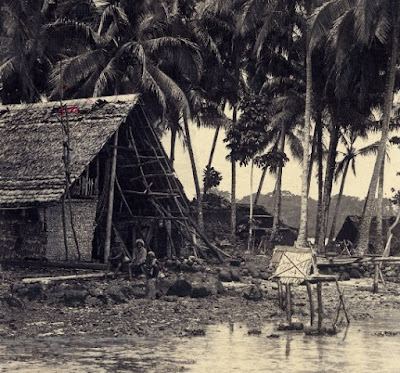
A small 'skull house' standing in front of a larger building in the Solomon Islands

The Skull House on display in the British Museum (Room 24)


Last Friday I attended the first of a series of short gallery talks at the British Museum which is endeavouring to meet this debate and facilitate this kind of reflection. This is something which has been in development for a while, but the initial coverage in the Press is painting this as a defensive response to independent initiatives to highlight the colonial aspect of museums and their histories. In this talk the curator circumnavigated a single showcase in the Wellcome Trust Gallery of Living and Dying (Room 24) – looking at a number of objects from the Solomon Islands, and thereby highlighting the ambiguity of the historical record. For instance, a skull house, an object which the museum records describe as “having been found under a cairn of stones.” – You don’t just find something under a cairn of stones, you first have to remove the stones to get at the object which is a deliberate act of seeking it out, with no mention of whether or not permission was sought from the local population who had originally placed the object under the cairn. And even if such permission was given, how are we (or even the collector at the time) to know that the person giving permission was in a legitimate position to do so? … Similarly that object – though it wasn’t actively sought by, or collected on behalf of the museum – may have been traded or handed down through several different hands or generations, then from one museum to another before it eventually reached the museum it is currently stored or displayed in. Does that make the current owner complicit in its initial theft, appropriation, or acquisition, whether that initial collecting method (extraneous to the museum itself) was documented and so is provable as being legitimate or otherwise? 
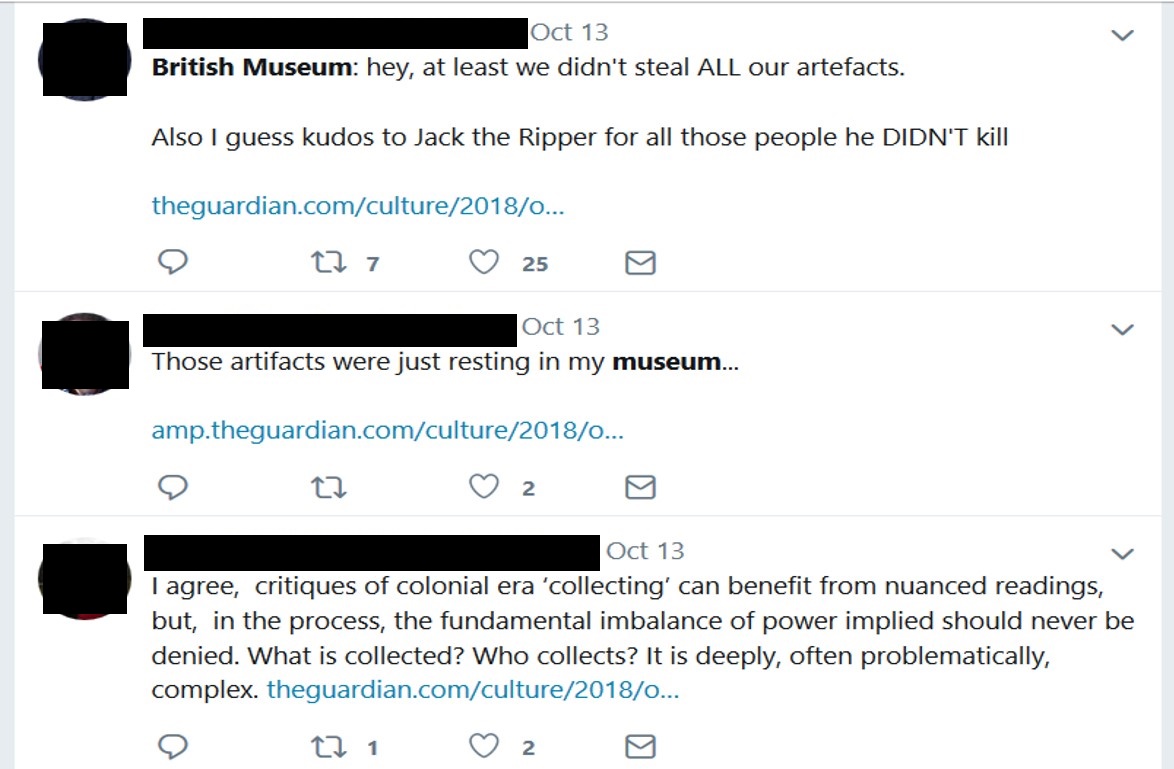
Some of the responses to the Guardian headline posted on Twitter


In most cases it’s a can of worms. But that’s not to say these questions shouldn’t be asked. They undoubtedly should be asked. But what we need to debate is how we respond and deal with such questions collectively. Maybe some of the answers will indeed prompt clear cases for restitution claims to be made and upheld. But also, for those objects of more ambiguous / unascertainable backgrounds or those legitimately collected when judged by today’s standards, perhaps we can view their being preserved in a museum as being a good thing? – There are many instances of museum curators working with local communities to better understand the objects held in their care, understanding the contexts from which these objects originated, as well as feeding back into those communities, who, in studying these objects for themselves, might re-learn lost techniques and skills of manufacture, and so on. The skull house mentioned above could well be an important example of this type of cultural survival. A British colonial official, Arthur Grimble, writing in his memoir, A Pattern of Islands (1952), gives a harrowing account of how Christian missionaries in the Gilbert and Ellice Islands (today's Kiribati and Tuvalu) compelled the local peoples to destroy this type of ancestral shrine which he says the zealous missionaries and their equally zealous indigenous converts found offensive in their ardent intolerance of what they perceived as superstitious 'paganism' and so destroyed in an unequivocal act of colonial violence.

This beneficent vision of the museum as resource as well as repository is a view which all museum scholars tend to agree on, after all knowledge is nothing if it is not shared. Perhaps in the past, knowledge – particularly in the colonial context – was power, hence in many ways the museum was both a functional database and a symbol of conquering and possessing other peoples, places, and resources, thereby being an implement of control; but in similar ways the knowledge which museums contain today can be reverted into something which goes deeper than simply giving back the material things of the past. They can be the means of giving back and growing that knowledge, refracting it in ways the old colonials could never have imagined! 
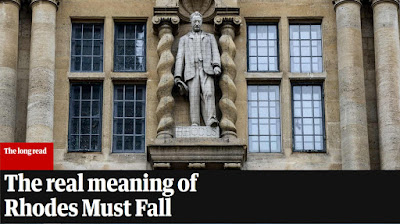
https://www.theguardian.com/uk-news/2016/mar/16/the-real-meaning-of-rhodes-must-fall
Click on the image to read the full article


And while we are thinking along these lines, it’s also worth bearing in mind that not all curators today are necessarily the direct descendants of those nasty old European colonial overlords, and those that are their descendants (asides from the nuance that not all colonials were imperialists) don’t necessarily hold the same opinions as their forebears did in this respect. Modern museums are recalibrating – but they are huge lumbering oil tankers not zippy speed boats, it’s difficult for them to comprehensively change direction overnight. But if you look closer, as this new series of gallery talks at the BM show, this generational shift is beginning to assert itself. The BM will look like a very different place in a few years’ time, because that’s what it does – it reflects the world which created the museum back then, as well as the world which continues now to create it over anew.

The modern museum is in one sense and memory bank, but it is also an active mind which is there to be collectively and individually engaged with by everyone who cares to use it. Automatic assumptions are exactly the kind of things which need to be challenged on multiple levels for any debate to have a constructive and meaningful outcome. There is no point being reductive about these questions, otherwise we are no better than that which we condemn. Broad brushes sweep both ways, but in sweeping out the bad we need to ensure we don’t inadvertently sweep out the good as well. Rhodes mustn’t simply fall, he must be reassessed, re-categorised, re-positioned, and above all – he must be remembered – otherwise the past has no future. Perhaps our minds need decolonising as much as our museums do?


~


Please note the views expressed in this article are mine alone and are not intended to represent the official position of the British Museum.

* NB - For more detailed information and informed discussion concerning Lord Elgin's firman, see: Dyfri Williams, 'Lord Elgin's firman,' Journal of the History of Collections, Vol. 21, No. 1 (2009), pp. 49-76


~

Also on 'Waymarks'


1 October 2018

Botanical Beginnings in the Sino-Tibetan Borderlands


https://images.hollis.harvard.edu/primo-explore/search?query=any,contains,ernest%20henry%20wilson&tab=default_tab&search_scope=default_scope&sortby=rank&vid=HVD_IMAGES&facet=creator,include,Wilson,%20Ernest%20Henry,%201876-1930,%20American,%20English&lang=en_US&offset=0
Bridge at Shih-chuan Hsien, West China, 1910
I’ve spent a large part of this year following botanists through the Sino-Tibetan borderlands, tracking them through various texts – both published and unpublished. The hey-day of Western explorers of this ilk is certainly the early decades of the twentieth century. Many of these individuals from Ernest Henry Wilson through George Forrest, Reginald Farrer, and Joseph Rock, to Frank Kingdon Ward, George Sherriff and Frank Ludlow, all wrote travelogues of their remarkable journeys – but probably the best place to start on such a topic is Euan H. M. Cox’s Plant-Hunting in China: A History of Botanical Exploration in China and the Tibetan Marches (1945). Cox was himself a botanist and travelled in this region at the same time, and so he provides a uniquely interesting angle on this last hurrah of great explorers conquering the final ‘blank spaces’ on the map (as he and several of his contemporaries thought of it). There were a number of Westerners based in China who dabbled their green-fingers in the subject in the nineteenth century. For some it was simply a hobby, for others it was a more serious minded pursuit. Perhaps the most famous of these individuals is Robert Fortune, who is credited with introducing the tea plant to India from China. But it was only in the early years of the twentieth century that the professional plant hunter really managed to get a firm foothold enabling the ‘opening up’ this biodiversity “hotspot.” Indeed, the Hengduan region of China covers a vast region of some 300,000 square miles (500,000 square kilometres). It contains over 12,000 species of vascular plants, with thousands of endemic species and genera included within this astonishingly varied array of vegetation, making it one of the most botanically rich and interesting places on the face of the earth. Curiously though, at this time, given the colonial interest in exploiting natural resources for profit – the main driver behind this upsurge in botanical exploration at the start of the twentieth century wasn’t so much a ruthless search for timber, rubber sap, or cereal crops, but was mainly spurred by a quest to beautify the ordinary gardens of the West with wonderful, and often fragile and delicate flowers.

Min Valley, south of Sungpan, West China, 1910 (Havard / Arnold Arboretum)

According to Cox, the transition from amateur to professional botanist in China was first embodied in the person of Dr Augustine Henry (1857-1930): “At the start [Henry] made no pretence of being a botanist. All the study he had had in that subject was for the knowledge necessary to obtain his medical degree. Indeed in a letter written from Ichang [Yichang, Hubei] he admitted that he took to collecting plants from sheer boredom: “Oh, if you knew the weariness of the exile’s life. I have become a great collector of plants, and after exhausting the neighbourhood I thought of going into the mountains, so I spent six months in two journeys into the interior.” He did not start collecting until he had been three years at Ichang.”

Augustine Henry in China
Henry was actually a member of the Chinese Imperial Maritime Customs Service, recruited by Sir Robert Hart in 1879. He first arrived in China in 1881 and retired from the Service in 1901. During that time he immersed himself in the study of plants and began corresponding with many of the directors of the leading botanical gardens, such as at Kew in the UK and the Arnold Arboretum in the USA, as well as the major commercial nursery companies, such as Veitch and Bees, sending plants and seeds to them. These recognised authorities greatly encouraged and supported him in both his botanical studies and his collecting work. They sent him articles and papers which he studied and absorbed with great proficiency. He was very much welcomed at the Royal Botanical Gardens in Kew when he made a visit during a period of home leave in 1886. Consequently, as his confidence and his knowledge grew, he rapidly became the acknowledged authority in the West China region; yet he remained keenly aware of his limitations and as such he always sought to act as a useful conduit to the work of others in the botanical field.

Other Customs Commissioners across China, such as Hosea Ballou Morse, commissioned Chinese collectors to work on Henry’s behalf and sent him specimens. Henry even managed to engage his friend, Pierre Bons D’Anty, the French consul at Szemao (Simao), near the border with French Indochina (Vietnam), to collect for him as well. He also corresponded with Arthur Bulley, the head of Bees Ltd, a leading nursery company in the UK, sending him seeds. The two men eventually met in England when Henry retired from the Customs Service in 1901. Bulley confided that he hoped one day to be able to send out a collector to the West China region which he subsequently did in 1904 and 1911 when he financed expeditions by George Forrest and Frank Kingdon Ward. Henry had always advocated the need for genuine scientific exploration of this botanically lush borderland region, and had frequently taken every opportunity to encourage others to sponsor such expeditions to the region. Writing to Professor Charles Sargent, Head of the Arnold Arboretum, Henry stated his opinion that: “Yunnan is a splendid ground for the anthropologist, ethnologist, zoologist, geologist: and I should very much like to see a trained expedition set out to explore – we who are on the spot are too busy with our ordinary duties to go in seriously for any such studies.”

In response Sargent repeatedly expended a great deal of effort in trying to recruit Henry to lead such an expedition himself, but Henry repeatedly declined Sargent’s overtures, on one occasion saying that “I could scarcely be expected to resign from my position in the Customs, unless I saw an opening equally good. I am less loath to refuse, because I know that remaining in the Customs I still do good service to botany.”

A. Henry & H. J. Elwes
However, when he finally left the Customs Service and quit China Henry spent much of his time working on his collections at Kew. He went on to pursue a successful second career in forestry, studying first at the French School of Forestry in Nancy and later at Cambridge University, publishing a seven volume work on The Trees of Great Britain and Ireland (1907-1913), co-authored with H. J. Elwes. In 1913 he became the first professor of forestry at the Royal College of Science in Dublin. Having made the transition from talented amateur to recognised academic authority Henry continued to be a pivotal person in the network of botanists working in West China, all of whom essentially followed in his footsteps. He helped to spur the careers of several by recommending them to the directors of the large botanical gardens and institutions, such as the Royal Horticultural Society, and he regularly gave them practical advice and support in their continuing work. Not least among them was Ernest Henry Wilson, who acknowledged his debt to Henry, the ‘scholarly Irishman’ who had been a mentor to him when he first arrived in China.

Ernest Henry Wilson
Cox describes the best qualities of the professional plant hunter in relation to Ernest Henry Wilson (1876-1930), whom he saw as representing the first truly expert collector to operate in West China. Such a specialist “spends most of his life collecting, knows his plants, knows his job and knows his country. He works by routine, visiting an area to see what is to be seen and returning later to collect the seed harvest. He works for two masters, the botanical institution that is interested in herbarium material and the gardener who is keen to grow new plants. As a rule this kind of dual command works harmoniously and does not clash. The collector sets out with a definitive object in view, covers an area limited in extent, and does not run haphazard over the country. Often collecting is the man’s livelihood; always is it taken seriously.”

Wilson was certainly a man of exceptional diligence, with a meticulous eye for detail. He began his working life as an apprentice at the Hewitt Nurseries in Solihull. He then went on to work at the Birmingham Botanical Gardens whilst also studying in the evenings at the Birmingham Technical School, where he received the Queen’s Prize for botany. In 1897 he joined the Royal Botanic Gardens at Kew, continuing to study for the Higher Grade examination in horticulture at the Royal Horticultural Society, which in turn enabled him to attend lectures at the Royal College of Science in South Kensington. He left Kew to take up studying full time at the Royal College with the intention of gaining the necessary qualifications to become a teacher of botany. But his life changed course when, having been personally recommended by Sir William Thiselton-Dyer, the director of the RBG Kew, he was offered the opportunity to become a plant collector in China for James Veitch and Sons.

Davidia involucrata, at the Royal Botanic Gardens, Edinburgh

Père Armand David
He first travelled to China in 1899, charged with finding the source of Davidia involucrata, known informally as the dove or handkerchief tree, because of its remarkable and distinctive flowers, which Augustine Henry described on first sighting in 1888: “It seemed as though the branches had been draped in thousands of ghostly-white handkerchiefs.” This species of tree had first been seen and reported on in 1869 by Père Armand David, a French missionary, after whom it was given its scientific name. It really is quite a sight to behold when it is in full flower and its branches seem to be limply hung with gently fluttering white bracts. I saw it for the first time earlier this year at the Royal Botanic Gardens in Edinburgh.

Davidia involucrata, at the Royal Botanic Gardens, Edinburgh

Asides from its main object, Wilson’s first expedition was highly successful, collecting many other plant and seed specimens of hundreds of other species over the course of two years travelling in the borderlands. He made a second expedition for Veitch and Sons before he took up an offer to join the staff of the Arnold Arboretum, having made a favourable impression upon Charles Sargent whom he had met and befriended while passing through the United States on his first journey to China, thereby transitioning from commercial plant hunter to scientific collector and academic. 

Wilson on one of his houseboats in China (Harvard / Arnold Arboretum)


Between 1899 and 1911 he made four separate plant collecting trips to China, the first two on behalf of Veitch and Sons and the second two on behalf of the Arnold Arboretum, covering vast areas in the provinces of Hubei, Sichuan, and Yunnan. In April 1919 he was appointed Assistant Director of the Arnold Arboretum and continued to travel, visiting countries such as Australia, New Zealand, and India, as well as parts of Central and Southern Africa, and various parts of Asia, such as Singapore, Japan, and Korea. Whilst travelling in Australia he was horrified at the extent of commercial deforestation occurring there unchecked, describing it as a kind of “Arboricidal mania” “Few seem to sufficiently appreciate what an important factor trees are in the wealth, health and beauty of a country. When you destroy the forests you upset the balance of nature. Besides the aspects of utility and beauty trees play an important part in health. They live on the very gas (carbon dioxide) that is poisonous to the animal kingdom, and if the vegetable kingdom were destroyed the animal kingdom would automatically die, too … The present generation must remember that it only holds the forests in trust for future generations.” He later succeeded Charles Sargent as the director of the Arnold Arboretum when Sargent died in 1927, representing quite a career trajectory from his early days and not least for one still relatively young. Wilson was only 54 years old at the moment of his and his wife’s untimely deaths in a road accident in 1930.

Wilson in Korea


Wilson was a self-made man. A rigorous and successful academic, he gained many awards and several honorary degrees in the course of his career. He was more than simply a botanist though, as many of his written works also display an astute interest in the customs and cultures of the peoples of the regions he travelled through. He was also an expert photographer who always carried very cumbersome and fragile Sanderson glass plate camera with him which he used to great effect. He was probably initially coached by his neighbour from a couple of doors down on Gloucester Road in Kew, the photographer, E. J. Wallis, who later assisted him with the processing and developing of his plates on his return from China. But even the most cursory of glances through Wilson’s photographic catalogue clearly shows that he had a natural ability for seeing and framing his shots. His dedication to scouting locations, then scoping and preparing views over the course of several days at a time, waiting until the lighting conditions were just right, have resulted in a unique collection of exceptional photographs of the highest quality, primarily documenting plants and trees but also recording details of his journeys, the modes of transport he used, as well as the peoples and places he encountered in order to form a comprehensive visual archive of the experience of botanical exploration. Cox also noted that Wilson “was a writer of many parts” – “he could give information clearly, readably and without frills in A Naturalist in Western China, one of the most informative books on botanical exploration ever written; he could be as popular as you like writing for the large, sprouting American gardening public in Aristocrats of the Garden, when publicity gave him the nickname of “Chinese” Wilson, a name which he good-humouredly put up with and secretly disliked; he could lecture extremely well. But in whatever mood he always insisted on being accurate, and he rarely made a mis-statement.”

Wilson's caravan of porters and assistants, China, 1908 (Harvard / Arnold Arboretum)

In my family there’s always been an old adage that ‘gardeners are always the calmest, quietest, and the wisest of folk.’ Wilson was one of those kind of men. Indeed, in some respects, Wilson was a highly perceptive man with a global vision and scientific wisdom which is starkly prescient when read now, in the light of today’s reality, as we begin to reap the bitter rewards of a blinkered Anthropocene era. A modern epoch, less than a century in age, which has failed to heed the entirely rational conclusions of an enlightened and attuned man, such as Ernest Henry Wilson, who, when writing in 1930, observed that: “In the Bible we are told that in the first garden God planted ‘The Tree of Knowledge of Good and Evil’, and in the old Norse Sagas the Oak and Ash are frequently mentioned. Priest and poet in every land have sung their praises and down the ages a mighty literature on tree lore has been accumulated. From early times trees have afforded shelter, food, and clothing, and have exercised a tremendous influence over daily life. The more simple the people the greater their appreciation, at least so it would seem since as nations became civilized they one and all by fire and axe have destroyed the friendly trees and of these vandals the white man ranks head and shoulders above all others. From the early stages of his colonizing days down to within a few years of the present, wherever he has gone he has laid waste the tree wealth of the lands in an effort, often in vain, to make a blade of corn grow where two trees grew before.”


Wilson in Taiwan


References & Further Reading

E. H. M. Cox, Plant Hunting in China: A History of Botanical Exploration in China and the Tibetan Marches (London: Collins, 1945

Fa-Ti Fan, British Naturalists in Qing China: Science, Empire, and Cultural Encounter (Cambridge, Mass.: Harvard University Press, 2004)

David E. Boufford, ‘Biodiversity Hotspot: China’s Hengduan Mountains’, in Arnoldia, Vol. 72, No. 1 (2014), pp. 24-35

Susan Kelley, ‘Plant Hunting on the Rooftop of the World’, in Arnoldia, Vol. 61, No. 2 (2001), pp. 2-13

Helen Dillon, ‘In The Footsteps of Augustine Henry’, in Irish Arts Review, Vol. 29, No. 2 (Summer, 2012), pp. 110-113, p. 111

E. Charles Nelson, ‘Augustine Henry and the Exploration of the Chinese Flora’, in Arnoldia, Vol. 43, No. 1 (Winter, 1982-1983), pp. 21-38

Seamus O’Brien, In The Footsteps of Augustine Henry and His Chinese Plant Collectors (New York: Garden Art Press, 2011)

Ernest Henry Wilson, A Naturalist in Western China with Vasculum, Camera, and Gun. Being Some Account of Eleven Years’ Travel, Exploration, and Observation in the More Remote Parts of the Flowery Kingdom (London: Methuen & Co., 1913), 2 Vols.

Ernest Henry Wilson, Aristocrats of the Garden (London: Williams & Northgate, 1938 [1917])

Peter J. Chvany, ‘E. H. Wilson, Photographer’, in Arnoldia, Vol. 36, No. 5 (September-October, 1976), pp. 181-236

Richard A. Howard, ‘E. H. Wilson as Botanist’, in Arnoldia, Vol. 40, No. 3 (May-June, 1980), pp. 102-138

Richard A. Howard, ‘E. H. Wilson as Botanist’, in Arnoldia, Vol. 40, No. 4 (July-August, 1980), pp. 154-193

Alfred Rehder, ‘Ernest Henry Wilson’, in Journal of the Arnold Arboretum, Vol. 11, No. 4 (October, 1930), pp. 181-192

Alfred Rehder, ‘Ernest Henry Wilson (1876-1930)’, in Proceedings of the American Academy of Arts and Sciences, Vol. 70, No. 10 (March, 1936), pp. 602-604

Roy W. Briggs, Chinese Wilson: A Life of Ernest H. Wilson, 1876-1930 (London: HMSO, 1993)

Denise M. Glover, Stevan Harrell, Charles F. McKhann, & Margaret Byrne Swain (eds.), Explorer’s & Scientists in China’s Borderlands, 1880-1950 (Seattle & London: University of Washington Press, 2011)


Tea porters, en route to Sungpan, West China, 1910 (Harvard / Arnold Arboretum)


Ernest Henry Wilson Photographic Archive at Harvard University / Arnold Arboretum 


Interview with Ernest Henry Wilson's biographer and great nephew, Roy Briggs (in three parts):


Also on 'Waymarks'