Showing posts with label Hong Kong. Show all posts

1 February 2020

Tian Tan - The Big Buddha of Lantau


Flying from Tokyo to London in 2007 I had a stopover of a couple of hours in Hong Kong. Too long to sit about in the airport, but not really long enough to do anything else. I’d been to Hong Kong several times before, but I’d never visited the Big Buddha on Lantau, the same island as the airport. But what the heck, I thought – I’d take a chance and be adventurous. Outside it was a bright sunny day with blue skies. So instead of waiting in the transfer terminal I passed through immigration and with my passport freshly stamped, I headed down to the taxi rank where I jumped into the back of a turquoise cab and asked the driver to take me to the Tian Tan. Normally you would probably choose to take the cable car from the airport over the hills right up to the top of the ridge where the Big Buddha sits serenely gazing out over the green hills, but at that time the cable car was closed indefinitely due to on-going maintenance issues. So the quickest way that day would be by taxi. Another one of my madcap dashes to squeeze the most out of every flying visit I ever seem to make (see here)!


It was quite a long drive, through the small town streets and then slowly zig-zagging up the hillside roads through the valleys, past a prison and a reservoir. The roads getting steeper as we climbed. We had to pause part way up as there was roadworks ahead – a huge machine with an industrial hose mounted on a truck was blasting concrete against the hillside above the road, reinforcing the cliff-face to prevent landslides. I didn’t know it then but some friends of mine later said they’d got stuck at this point a few days before and had sat in a traffic jam for a couple of hours as banksmen with Stop/Go signs alternated the flow of traffic going up and coming down, everyone inching along tediously in the baking hot sunshine – little did I know the risk I was running, given that my flight was departing in just a couple of hours’ time!


When the taxi finally reached the top of the ridge I asked the driver if he’d wait for me. But he shook his head and pointed to a taxi rank at which I could see two turquoise taxis waiting, telling me I could pick up another cab there when I was done. So I thanked him, paid him my fare and watched as he zipped away, heading back down the hillside as fast as he could.


Before climbing the steps to the Big Buddha I decided to take a look around the Po Lin Monastery. The monastery was first established in 1906, but only properly founded as the Po Lin (meaning Precious Lotus) Monastery in the 1920s. It is dedicated to Guanyin, and the main temple building houses three bronze statues, representing the past, present and future Buddhas. The Tian Tan, or Big Buddha statue on the peak overlooking the monastery was built much more recently in 1993. The monastery itself was quite a secluded place until the 1970s when it first opened its doors to visitors – now, especially since the building of the Big Buddha, it’s one of the main tourist attractions in Hong Kong, visited by coachloads of tourists daily. However, I was lucky in that it was relatively empty the day I visited. Great sticks of incense burning in the courtyard outside. It seemed blissfully quiet and peaceful.


I climbed the long flight of steps up to the Tian Tan – 268 of them according to my guidebook, not that I counted them myself. The great Buddha looming overhead is quite an imposing sight as you climb, and the view from the platform on which the Buddha sits in serene meditation is quite something else. The Buddha’s right hand is raised in a gesture that signifies the removal of affliction and his left rests in his lap in an open gesture of generosity. Unlike the other great Buddha statues elsewhere which face south, this Buddha faces north. The circular stone dais supporting the giant bronze lotus flower on which he sits is modelled on the Altar of Heaven in Beijing, but unlike the Altar of Heaven it’s made of grey stone rather than polished white marble. Surrounding the Buddha are six smaller bronze figures, representing the Offerings of the Six Devas – each offering in turn, a flower, incense, a lamp, ointment, fruit, and music – symbolising the Six Perfections of generosity, morality, patience, zeal, meditation, and wisdom. The Big Buddha itself is also made of bronze – it is 34 metres tall and weighs over 250 tonnes. It was constructed of 202 separate pieces of bronze on a steel framework. Inside the statue’s base I saw a set of photographs showing the statue during the various stages of its construction, each photo accompanied by a very British caption extolling the technical marvels of this feat of engineering in terms of the relevant facts and figures. A list of statistics and Meccano-set-like instructions which, I thought, rather robbed the Great Bronze Buddha of any sense of reverential awe. More a case of empirical facts and figures rather than faith and feeling, unlike going inside the giant bronze statue of the Daibutsu at Kamakura in Japan (see here), which has the patina of some eight centuries long since passed to burnish that sense of deep time and the sanctity of genuine belief. Initially I felt much the same about the Che Kung Temple and Ten Thousand Buddhas Monastery at Sha Tin in the New Territories when I first visited these too – there’s just something seemingly not so very sacred about modern concrete effigies, even if they do impress by their sheer size and gaudy decoration. I wonder now though how they might mellow with the passing centuries? – Even the Daibutsu must have looked new and shiny once upon a time long, long ago …


Time certainly was ticking however. Glancing at my watch I realised I should be getting back to the airport where I’d still need enough time to check-in and pass back through immigration and security before boarding my onward flight. Heading back down the steps I was rather dismayed to find the taxi rank completely empty. There was nothing to do but wait. The place was eerily quiet. As the minutes ticked by I tried not to fidget too soon with a growing sense of unease, but luckily before my steadily growing anxiety really got to sink its fangs in, compulsively causing me to clock up increasingly fretful glances at the seemingly-speeding-up minute hand of my watch – a turquoise taxi appeared, and laboured round the roadway to drop off a couple of tourists arriving just in time to catch the onset of late afternoon and an enchanting sunset if they chose to stay that long. As for me though, I hopped quickly into the back of the cab and was soon whizzing back down the winding roads, descending the hillside, past the hose-like neck of the industrial dragon breathing concrete across the flank of the mountainside, zipping back through the little towns to the airport where my onward flight was waiting to take me back to London – my little adventure having been worth the risk to pay my respects to the peaceful Tian Tan, the Big Buddha of our modern age, perched upon the hazy hillside looking far out across the green hills and valleys to a calm and serene sea.


Also on 'Waymarks'


1 May 2019

Cold Case - Kowloon-Canton Railway


Most historians, like all good noir-ish detectives or private eyes, have cold-case files piled up in a desk drawer somewhere. The research projects that never got properly started, or had to be abandoned for lack of evidence. Promising leads that tailed off or simply led to dead ends. They get shelved rather than binned in the hope that something will eventually turn up which will set the wheels in motion again. Flipping a blue flashing light on the roof. Spurring us into action as some new source material provides us with a fresh scent to set the tracker dogs onto; something which might enable us to pursue our enquiries to a successful conclusion.

Kowloon Railway Terminal before demolition, all that remains today is the clock tower.


I have one such cold case regarding the opening of the Kowloon-Canton Railway (KCR) in 1910. And, as with all good noir-ish detective stories, it begins with a location, a suspect, a probable motive, and a part confession. All the signs are there, but I still just need that one crucial bit of evidence to clinch it and make my case watertight. It all began with a passage in Paul Henry King’s memoir, In the Chinese Customs Service: A Personal Record of Forty-Seven Years: 

“The last Viceregal function I assisted at was on the 7th April, 1909, on the occasion of laying the foundation-stone of the Terminal Station of the Canton-Kowloon Railway at Tai-sha-tan, just outside the East Gate of Canton City. The Governor of Hong-Kong and the Colonial Secretary came up for the ceremony, which was very well staged and came off without a hitch as far as the Chinese were concerned. It struck some of us that the Hong-Kong Governor's speech seemed to insist rather too much (for good taste) on the benefit to China of railway connection with Hong- Kong. His whole attitude reminded me of Sir Robert Hart's anecdote about Wen Hsiang's remark — "That the British invariably gave good advice to China in an unpalatable form" — and almost produced the impression that he was taking advantage of the occasion to let the Viceroy know what he thought of the Canton Government. However, His Excellency Chang seemed not a penny the worse and beamed on the just and unjust alike, as only a man with a swivel eye can. I was close by their two Excellencies most of the time and enjoyed the situation not a little.” 

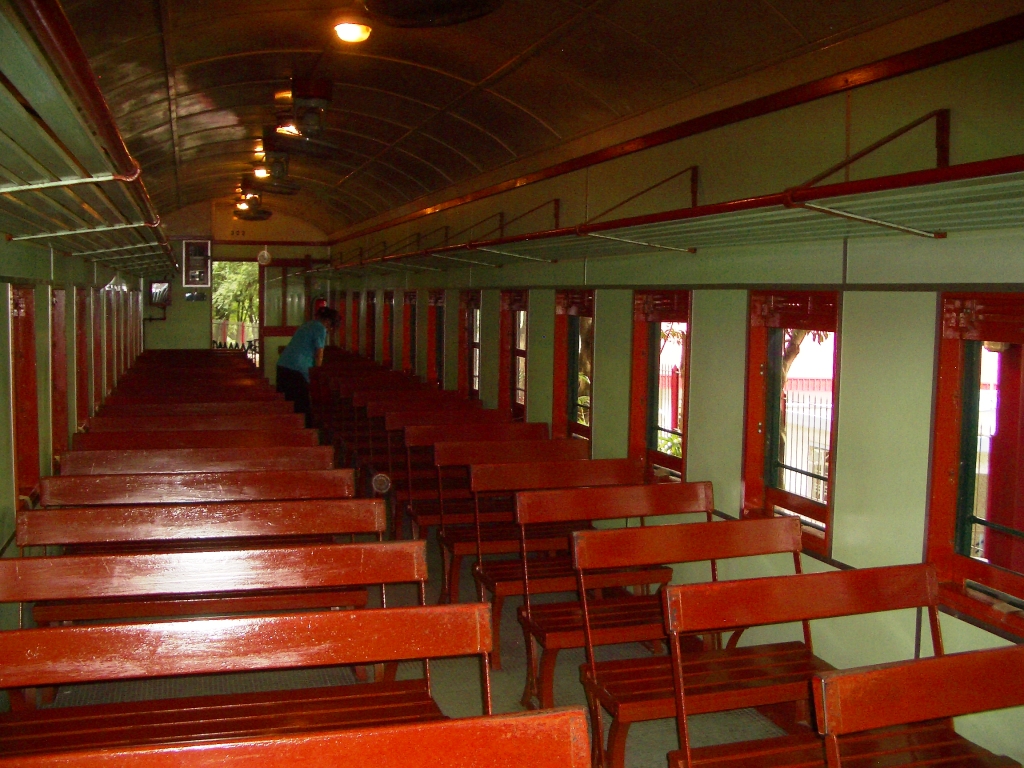
This passage came to mind when I was working in Hong Kong over ten years ago. I’d often walked past the old clock tower down by the Star Ferry terminus. It’s all that’s left of the original Kowloon terminal of the KCR line (which still operates today). But it was only when I had a spare day free, and was wondering what to do, that I decided to visit the Railway Museum at the old Tai Po Market Station. This station was taken out of service when the KCR was electrified in the early 1980s. It was decided to preserve the station building, which was built in 1913, due to its unique architectural style which is reminiscent of typical south China temple buildings. Now run by the Hong Kong Leisure and Cultural Services Department (LCSD) the museum is free to visit and consists of the main station building with its original ticket hall, plus a number of railway carriages and a couple of locomotives, all preserved from different eras. It was in one of the station side rooms in which there are display panels explaining the history behind the foundation and construction of the KCR where I came across the following photograph:

Banquet to celebrate laying the foundation stone of the Canton Terminal, 1909.


This image shows Chinese and British officials at a banquet in 1909, celebrating the laying of the foundation stone for the Chinese Section of the line at the Canton Terminus (Tai Sha Tan). Given Paul Henry King’s account of this event in his memoir it seems almost certain that he is present somewhere in this image (or in the close vicinity of it), but where exactly is another question altogether! – I’ve no idea if he’d be seated at the top table or if perhaps he’s one of the chaps seated at the two tables flanking the sides, perhaps with his back to the camera? All the versions of this photo which I’ve since found are far too grainy or faded to see sufficient detail. Nevertheless, it’s fascinating to think he’s there and that this is a photograph he’d recognise intimately. But what really caught my eye that day were the following two photographs which the caption indicates were taken about a year or so later:


Lo Wu, 1st Ocober 1910.


The first shows the Acting Governor of Hong Kong, Sir Henry May, and his wife “inspecting the tracks”, and the second is a more general view of the guests attending the opening of Lo Wu station on 1st October 1910, where the Chinese and British sections of the KCR met. You’ve probably noticed that the same unnamed yet clearly eminent Gent appears front and centre of both images. In the second he appears to be standing with a woman whom we might suppose to be his wife, and to his left are three Chinese officials, who – to my mind’s eye – look like they might possibly be local Customs officials. This could also make sense if the unidentified Gent is Paul Henry King, then Commissioner of the Chinese Customs Service at Canton. In terms of dress and demeanour, the couple do look a lot like the photos I’ve seen of Paul Henry King and his wife, Veronica (also known as Madge, but whose real name was Alice Margaret). His moustache and his distinctive collar, neck tie and dress coat do seem similar to one of the fellows seated at the top table of the 1909 Canton photo – if you squint really, really hard! … Initially I couldn’t help feeling really excited – but I knew I’d have to check my facts before I properly congratulated myself on the 'sure certainty' of my remarkable find. It’s important never to let imagination impinge too far upon instinct and so over-determine an inclination towards an idea, no matter how probable or likely it might outwardly seem ... Nothing is ever certain until it is totally clarified beyond any doubt and backed up by genuine, demonstrable proof.

Lo Wu, 1st October 1910.


So firstly, I went back to Paul King’s memoir. Naturally, I didn’t have a copy of the book with me at the time of my visit to Hong Kong. I could only very vaguely remember the passage in its broadest outline. And so later on, re-reading it closely, I encountered a problem. The passage quoted above was preceded by the following sentence: “But my sands at Canton were now running out, as I had been granted two years' leave of absence as soon as my successor could take over the port.” And the concluding lines of the passage (and of that chapter) only reinforced the fact: “I handed over charge of the Canton Customs to my old friend and colleague, J. F. Oisen (now Danish Minister in Peking), on the 8th May, 1909, and left for Hong-Kong on the 11th May. I had paid a farewell visit to the Viceroy on the 10th, and he did me the great honour of coming in person to see me off. All our friends—native and foreign—did the same, and overwhelmed us with kindness and regrets.”

Lo Wu, 1st October 1910.


The pages of the subsequent chapter only bore this point out further. The Kings were “back home” in the UK when the event at Lo Wu had taken place. They didn’t return to China until March 1911. But I couldn’t help staring at the figure in the two photos. The more I looked the more I wanted to doubt the published memoir with its black and white dates regulating the text to a clear timetable of events. I suspect Paul King may well have kept a diary which he’d most likely referred to religiously whilst writing his memoir, like a metronome keeping the chapters neatly and orderly to time. But I kept coming back to those images of Lo Wu. The chap in the photos looked so similar to Paul King to my mind’s eye that it niggled me – I wanted to be sure. If this fellow wasn’t Paul King, who was he?

The inaugural train at Lo Wu, 1st October 1910.
  
The only other way I could think of to be completely certain was to go back to the original source and see if anyone I knew in the LCSD might have access to the original photograph, and to ask them what records there might be connected to it which might name the individuals it pictures. A friend of mine who works at the Hong Kong Heritage Museum very kindly said she’d look into it for me and see what she could find. A few weeks later I received an email from her. She’d spoken to a couple of colleagues, but all they could find amounted to much the same information as that which was used in the captions given on the wall at the Railway Museum. There were no names known other than that of the Acting Governor and his wife. Hence all my lines of enquiry and all my leads in this process of investigation didn’t just reach the end of the line, but rather firmly hit the buffers and could go no further. Whoever this couple is remains a mystery to me. – Unless something else turns up, in due course, which manages to get me back on the tracks and under full steam again. Until then, all I can do is stare at these black and white figures in these grainy old photographs and wonder who these people are. 

Lo Wu, 1st October 1910.


Meanwhile, despite the clear evidence of Paul King’s own memoir, there’s still a part of me that doubts the seemingly incontrovertible evidence of his own writing. Hence, whenever I look at these photographs, I still can’t help vacillating between my ardent wish for it to be the Kings (simply based on the similarities of their looks, their dress and their demeanour – but then, how many eminent Edwardians all look exactly like this? – Answer: Lots of them!), and my equally strong scepticism, which wonders if either the photos or the memoir might perhaps have been incorrectly dated? – The fact-checking historian in me still obsessively requires that I see the names (theirs or someone else’s) pencilled on the back of the photograph, or typed up on a guest list published in some forgotten contemporary local newspaper, or someone else’s memoir which says they were or weren’t there in the same company as Paul and Veronica (or, more likely, their doppelgangers) at this event on that particular day in October 1910 … 

Canton Railway Terminal, 1st October 1910.


But then, these are exactly the kind of sources which might very well suddenly appear as if out of nowhere; stumbled upon in some obscure publication, hidden in some library somewhere; chanced upon by accident whilst looking out for something else entirely. The key documents that will answer the riddle as to who this man really is and why he was there – was he the man who replaced Paul King in his post at Canton? Quite possibly. – If I look at all the facts, my prime suspects are much more likely to be J. F. Oisen, or the unnamed Colonial Secretary. – But the niggle is that need to know. And that’s the joy and the frustration of doing this kind of research. It goes in fits and starts sometimes. Answering one question may well simply end up posing another in its place. Hence, tugging at threads which get knotted for a time, but then someday suddenly and unexpectedly start to unravel again. Like all good detective yarns, cold cases are never truly closed cases, just stories which haven’t been concluded – yet. – Best to keep ‘em peeled, eh! You never know what might turn up …


The modern Kowloon-Canton Train passing through Sha Tin Station, 2008.


Postscript: (21st January 2020) - Well, at long last it seems like the cold case I've described above might finally be closed ... Late last year I was made aware that Paul Henry King's diaries were due to be sold at an auction at Sotheby's, which was held on 12th November 2019 (Sale L19405 - Lot 277, see here), and so I was given a chance to see the contents pages fronting each diary, including the volume covering 1910 - and yes, it seems clear that, as indicated in his published memoir, Paul King was not in China at the time of the ceremony at Lo Wu. Hence it very likely is not him nor his wife in the photos of that event. Who these individuals are remains an open question; maybe it is J. F. Oisen, who took over from King as Canton Customs Commissioner, or perhaps it is someone else entirely? ... As is often the way when conducting historical research, answering one question, more often than not, tends to beget yet another question - and so it goes, question after question after question ... 

31 October 2012

"Living Fossils" - Horseshoe Crabs


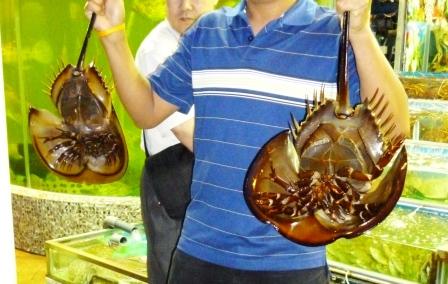
Earlier this year when I was in Hong Kong I went up to Sai Kung Town, a little fishing port in the New Territories, where I came across a curious sight. Down by the waterfront, which is lined with fish mongers shops and seafood restaurants, there are all sorts of weird and wonderful creatures populating the banked tanks full of gently percolating saltwater. Outside one of the fish monger’s stalls on the wet pavement there was a group of unusual looking creatures – a type of animal which I’d never seen before but knew of and was intrigued by: horseshoe crabs.

Horseshoe crabs are one of the world’s oldest marine animal species. They are thought to have been living in the warm shallow coastal seas for at least the last 300 million years – that’s 100 million years before the dinosaurs roamed the Earth! In that vast period of time the shape of the continents and the oceans have changed dramatically and thousands of other species have come and gone, evolved and perished, but the horseshoe crab has outlasted them all and has changed little itself in all that time. This odd looking creature is arguably one of the most successful – and useful (as I’ve since found out) – species on our planet.

Horseshoe crabs are a type of invertebrate (animals without backbones) classified as Arthropods (joint-legged animals). Other perhaps more familiar animals in this group are lobsters, crabs, insects, spiders and scorpions. Their bodies are divided into three parts: the prosoma, the front part consisting of the head and thorax which is covered by a hard shell or exoskeleton; the opisthosoma, which is attached to the prosoma by a hinge; and, the telson, or sword-like tail which they use to right themselves if they get flipped over onto their backs. They use their legs for feeding as well as moving. They don’t have jaws as such but instead have gnathobases, or bristles located near the base of the legs that they use for walking. The legs which they use for searching out food are called chelicerae. The gnathobases tear and shred the food they eat, usually clams or worms which they grub up from the seabed using their chelicerae as they move along. They have two primary compound eyes located on the top of their carapace or shell, plus several secondary eyes, some of which are located under the carapace too. As they grow they moult their outer shells, increasing in size by 25-30% with each moult. It takes about 8 to 10 years for horseshoe crabs to reach maturity. It’s not known how long they live, but some scientists believe that horseshoe crabs can reach ages over 20 years old.


Given that they have existed for so many millions of years with relatively little change horseshoe crabs are often described as “living fossils.” They are in fact the closest living relative of the trilobite, an ancient marine animal which flourished for around 270 million years before finally disappearing during the mass extinction at the end of the Permian era around 250 million years ago. Trilobites were highly diverse and geographically spread quite widely across the globe. In contrast, horseshoe crabs are limited to certain temperate regions of the Earth’s oceans, although they may have been more diverse and more widespread in the past. Nowadays there are four extant species: Limulus polyphemus inhabits the western Atlantic and Gulf coasts from North to Central America; Tachypleus gigas and Carcinoscorpius rotundicauda populate the Indo-Pacific region from the Bay of Bengal to Indonesia and Borneo; and, Tachypleus tridentatus (presumably the sort which appears in the accompanying photos that I took at Sai Kung) are found from the Philippines up to the southwestern seas of Japan.


Like the trilobites, horseshoe crabs are also found in the fossil record. In 2002 a remarkable horseshoe crab fossil was discovered in Bavaria, Germany – in which, not only the horseshoe crab itself but also its final track in the seabed was preserved. The horseshoe crab somehow fell into what was probably an anoxic lagoon (i.e. – there was no oxygen at the bottom), and so the creature having valiantly righted itself then managed to move some 9.7 metres before it finally succumbed to suffocation. The fossil and its preserved “death march” is thought to be around 150 million years old.

Living horseshoe crabs are also remarkably useful animals to humans and have been utilised in various ways for hundreds of years. Most notably they have been used as a source of food, for tool making (their tails making good spear tips), a nitrogen rich fertiliser, and as animal feed. More recently they’ve also been utilised in medicine too. The study of horseshoe crabs has greatly aided eye research and significantly advanced pharmaceutical testing. Plus studies and derivatives of the material which makes up their exoskeletons (chitin – a polysaccharide, or sugar polymer) has also aided practical advances in medical research (anti-bacterial sponges, dressings for burns, artificial blood vessels, contact lenses, blood cholesterol control, to name but a few), as well as improving water treatment and filtration processes, anti-fungal aids to agriculture, dietary supplements, and cosmetics, even toothpaste!

For more information on horseshoe crabs see the University of Delaware's Sea Grant Program website.

Afterword:  (17 November 2012) Earlier this week, I went to an excellent RGS lecture given by Richard Fortey, senior paleontologist at London's Natural History Museum and FRS. He was speaking about his latest book "Survivors: The Animals and Plants that Time has left behind" (Harper Collins, 2011), in which he discussed a whole host of weird and wonderful (and some quite ordinary) creatures which have managed to survive the various mass extinction events in the Earth's long history. He is an expert on Trilobites and naturally enough began his lecture with a look at the Horseshoe crab.


Also on 'Waymarks'


5 February 2012

The Star Ferry - Hong Kong

This New Year began for me with a trip to one of my favourite cities, Hong Kong.

Hong Kong currently bills itself as “Asia’s World City” and it is certainly a very diverse and cosmopolitan place. Hong Kong is famously a very densely populated city, but it’s also relatively easy to escape from the bustling streets to the much quieter atmosphere of the outlying islands or the hills of the New Territories. Amidst the tightly crowded skyscrapers and modern buildings amongst the streets and back-alleys it’s also possible to find traces of old Hong Kong – solid colonial era buildings and smoky, antique Chinese temples. One of my most favourite things in Hong Kong is the Star Ferry.

The Star Ferry now plies only two routes across the shimmering turquoise waters of Victoria Harbour. From Tsim Sha Tsui, Kowloon side, to Wan Chai and Central, Hong Kong island side (when I first visited Hong Kong several years ago it then plied four routes, but the routes to Hung Hom ceased last year). 

These quaint little boats, painted green and white, are quietly iconic. They are such a part of the fabric of Hong Kong that it would be hard to imagine the place without them. They are rather like a maritime version of London’s old red Routemaster buses.

Before the first regular ferry service people had always crossed the harbour strait in small sampans, but in 1870 a twin-screw wooden hulled boat from England, owned by a man named Grant Smith, began to ferry people from one side to the other. However, it wasn’t until 1888 that a regular scheduled service was set up. 

The “Kowloon Ferry Company” was founded by a Parsee merchant, a former cook, opium trader, and later hotel entrepreneur, named Dorabjee Naorojee Mithaiwala, who bought Smith’s boat. He later acquired two steam boats, named the Morning Star and the Evening Star. Within ten years the popularity of the service meant he was able to expand his fleet to four steam boats, the two new vessels being the Rising Star and the Guiding Star. Each boat could take up to one hundred passengers.  A local newspaper reported in 1888 that the ferry ran at all hours between Pedders Wharf and Tsim Sha Tsui on a 40 minute to one hour trip. On Mondays and Fridays, the service halted for the boat’s coaling. The first four boats were each single deck vessels, later the company would begin to run boats with two decks like those still in service today. The company was incorporated in 1898, becoming the “Star Ferry Company,” and was sold in the same year, just before Dorabjee’s retirement to India. It is said that the company name was inspired by the opening lines of Dorabjee’s favourite poem:

Crossing the Bar

Sunset and evening star,
And one clear call for me!
And may there be no moaning of the bar, 
When I put out to sea,

But such a tide as moving seems asleep,
Too full for sound and foam,
When that which drew from out the boundless deep
Turns again home.

Twilight and evening bell,
And after that the dark!
And may there be no sadness of farewell,
When I embark;

For tho' from out our bourne of Time and Place
The flood may bear me far,
I hope to see my Pilot face to face
When I have crossed the bar.

by Alfred, Lord Tennyson (1809-1892)


Today’s twin piers at Tsim Sha Tsui were built in the early 1950s. The present piers at Central were recently relocated due to foreshore reclamation work; the new fourth-generation building was modelled after the second-generation one which served the route a hundred years ago. 

Many of the boats currently in service in the Star Ferry fleet also date back to the 1950s, although a couple were built as recently as the late 1980s. The boats have a charm of their own which is hard to describe, it’s better to experience it first hand. They seem quaintly old fashioned in many ways, but they are still very much a functioning part of modern Hong Kong’s public transport system. The company does run a harbour tour route, but the ferry service itself is by no means a mere tourist attraction, albeit that most of the current guidebooks list the ferries as a ‘must see’ element of a stay in Hong Kong. The Star Ferry certainly is the pleasantest way to cross from the mainland to the island or back again. It provides a picturesque view no matter what time of the day or night one chooses to cross. And the harbour itself is always so dynamic that there is always something to see – the graceful arc of a sea kite gliding on the wing and occasionally dropping to the water in the act of fishing, or a sampan precariously bobbing about like a popped champagne cork, looking as though it’s about to get clobbered by the ferry itself as it steams purposefully ahead across the strait, only to have the danger reversed moments later as one sees a giant cruise liner or heavily laden coaster bearing down on the ferry from the other side. 

Each crossing is a lively affair with the boat usually packed to the gunwales with passengers on both decks. The upper deck (slightly more expensive) is somewhat more genteel and offers better shelter fore and aft; the lower deck (slightly less expensive) is liable to a bit more noise and pungent diesel smells from the open doors of the roaring engine rooms below, but neither is particularly costly at either HK$2.50-HK$3.00 one way (roughly equivalent to 25 or 30 pence at present in the UK). The benches on each deck still look wonderfully Edwardian and are eminently functional with the back piece easily being tilted manually one way or the other depending on the direction of travel.

The crossing feels like a timeless part of Hong Kong’s existence. One sits on the boat or stands by the rail looking out at the restless, ever-changing face of the city on either side of the harbour. That timelessness is well caught in the opening pages of Richard Mason’s classic Hong Kong novel, The World of Suzie Wong (1957):

“The ferryboat came churning alongside and the crowd moved forward. We jostled together up the gangplank and chose one of the slatted bench-seats on the covered top-deck. The ferries were Chinese owned and run, and very efficient, and we had hardly sat down before the water was churning again, the engines rumbling, the boat palpitating – and we were moving off busily past the Kowloon wharves, past anchored merchant-ships, past great clusters of junks. Ahead, on the island across the channel, was Hong Kong, squeezed into a coastal strip a few hundred yards wide, with the miniature skyscrapers in the centre and on either side the long waterfront, stretching for miles, wedged with sampans and junks; behind rose the steep escarpment of the Peak, shedding the town and the lower social orders as it climbed, until at the higher altitudes there remained only a sprinkling of white bungalows and luxury flats inhabited by the elite.”

All that has changed in this description today would be that the skyscrapers are no longer miniature, but rank as some of the tallest in the world, and – sadly – there are no more picturesque looking junks beyond one or two occasional tourist curiosities. There are still plenty of sampans though.

I took these accompanying pictures on a crossing from Tsim Sha Tsui to Central shortly before the Chinese New Year celebrations last month. The first photo shows the Day Star, built in 1964; and the second picture shows the Meridian Star, built in 1958, moored alongside the Tsim Sha Tsui pier. The remaining photos are all of the Northern Star, built in 1959. Each has the capacity to seat 576 people.