
I think my fascination with the
River Mekong arose when I first read an article in the National Geographic Magazine in 1993, and recalling an iconic cover
photo from a few years earlier of a small, smiling barefoot Vietnamese girl
steering a coracle with a long pole, like a punt on the River Cam.* The article, which I think had
the title: The Mighty Mekong, or
something similar (sadly I no longer have my copy of it), was about a
remarkable journey – apparently the first to follow the Mekong from sea to
source. The National Geographic
expedition took three years and was recorded by the photographer, Michael
Yamashita, with some truly remarkable images (some of which you can see here).
It was these images which caught and fired my imagination, and I remember I
resolved at the time that one day I would go there to see this remarkable river
for myself. In 2009, some 16 years later, I realised that dream.


It is amazing to think that certain
geographical facts regarding the Mekong were still being contested and
established even at this very late stage of the twentieth century. It’s
especially of interest to our family, as Louis Magrath King (a collateral
relative of mine, and one of the subjects of my PhD research) is credited as
being the first European to travel and map a portion of the Mekong’s upper
reaches in Tibet. Two modern day explorers, one French and the other Japanese,
Michel Peissel and Masayuki Kitamura, each claimed to have located the exact
source of the Mekong in 1994. Kitamura’s claim is thought to have superseded
Peissel’s, and subsequent measurements by Chinese authorities have marginally
adjusted Kitamura’s measurements adding a further 5 km to the Mekong’s length.
Hence the Mekong is now said to be the twelfth largest river in the world,
measuring around 4,350 km in length, and an annual discharge of 475 billion
cubic metres into the South China Sea, with its waters gathered from a vast
drainage basin of some 795,000 square kilometres.

 |
| The Mekong, 1715 |
For most of its history it has been
a river which divides rather than unites its riverine peoples. It forms a
national boundary in many parts of its course, but more essentially, its rocky
upper reaches with many unnavigable rapids have physically prevented it from
becoming a conduit for people and goods as is the case with many other large
rivers, such as the Nile or the Amazon. Mekong – the name by which it is best known
around the globe is said to derive from the contraction of its Thai name, ‘Mae
Nam Khong’, meaning ‘Mother of the Waters’ – it has many other names: in
Tibet-China the ‘Dza Chu’, or ‘river of Rocks’, and ‘Lancang Jiang’, or
‘Turbulent River’; in Cambodia the ‘Tonle Thom’, or ‘Great River’; in Vietnam
it is both the ‘Song Lon’, again ‘Great River’, or the ‘Song Cuu Long’, or
‘Nine Dragons River’, a name which alludes to the many channels and rivulets
which make up its vast Delta region.


It was Vietnam’s Delta which I
visited in the summer of 2009. The following year I also travelled to within
striking distance of its upper reach in the China-Tibet borderlands. Touring
the Delta region in Vietnam using two distinct modes of transit – by bike and
boat – is by far the best way to experience the river up close. The Mekong is a
river of great transition, the geographical contrasts between its arid
mountainous origin and its vast fertile delta flats could not be more stark. In
Chinese territory it makes a rapid drop in altitude of some 4,500 metres. Early
European colonial adventurers – including the Portuguese, the Spanish, and the
Dutch – mounted limited expeditions from the 1540s onwards, but the first
major, concerted exploration effort was undertaken by the French in 1866, when
a three year expedition travelled from the Delta upstream to Yunnan Province in
China. The French Mekong Expedition was led by Ernest Doudard de Lagrée and Francis
Garnier, and is recounted in evocative detail in Milton Osbourne’s excellent
book, Mekong: Turbulent Past, Uncertain
Future (2000). I came across this book whilst I was in Hong Kong in 2007,
and reading it reignited the fire in my imagination to visit this marvellous
river. From the wonders of Ankor Wat to the horrors of the Second Indo-China
War, as depicted in Francis Ford Coppola’s Apolcalypse
Now (1979) – the river’s course, flowing through time and through the
different regional cultures who populate it, from China to Burma, Laos,
Thailand, Cambodia, and Vietnam, these countries and their different peoples
all make the Mekong an endless fount of fascination for any prospective
traveller.
 |
| Brick Kiln |
 |
| Fired & Unfired Bricks |

Milton Osborne describes that sense
of personal fascination well: “Like other
travellers, I treasure my own special memories of the Mekong. What I find striking
is how closely they accord with the memories and reflections of those who
travelled on and by it before me. They too marvelled at the spectacular rush of
water at the Khone Falls. And they remarked on the extraordinary contrasts of
the river where it flows wide and deep for long stretches before being suddenly
interrupted by rapids. I have found myself echoing their pleasure in the cool
misty mornings of Luang Prabang and sharing their discomfort in the heat of
high summer. Much of the wildlife that Father da Cruz described when he
travelled on the river in the sixteenth century has vanished, but the
kingfishers that were so often mentioned in nineteenth century descriptions are
still there, darting down from the trees with a halcyon flash to pluck a fish
from the water. And I have been struck, as have so many before me, by the
changes in colour of the waters of the Mekong. At Jinghong the river is rich orange-red
as it runs through the surrounding laterite hills. Further downstream at low
water it appears dark green. At noon it will be blue and silver; in late
afternoon a regal purple. As Francis Garnier rightly said, it is a singular and
remarkable river.”

But sadly all is not quite so
idyllic and as unchanging as it might seem on the Mekong. There are many
changes in its use, most notably with the swift increase in recent state-sponsored
projects to build hydroelectric dams at various points along its course by the
different countries through which it flows, most notably China. These projects,
although a seemingly logical step for countries – many with poorer economies –
to generate both jobs and electricity are of course also displacing
communities, disrupting water and sediment flows, and destroying wildlife
habitats, migration patterns and paths, as well as traditional fishing
industries, and the like. The cultural and economic impact of such large
national infrastructure projects can be devastating to local communities as
well as having greater geopolitical implications for those nations located
further downstream when they are undertaken without broader regional
international consultation and agreement. The blog East by Southeast frequently gives very good commentary upon these
issues (see here). Proving that while most major rivers of the world are mighty
elemental forces in their own right, mankind still has the capacity to do
significant damage to their integrity and the time honoured traditions they
have enabled to flourish for centuries. The Mekong may well have frustrated
earlier efforts by European colonials to tame it for the purposes of commercial
navigation, but nowadays it isn’t so much being tamed but rather killed off
by its domestication. Yet as with many wild beasts which mankind attempts to corral,
box in and pacify there will come a moment, probably out of the blue, when it
is least expected, when the Mekong will rebel and reassert itself. And when it
does, the resulting hubris for mankind will undoubtedly be as deadly as it is
devastating.


There is a Cambodian saying: “The Lao live near the water, the Cambodians
on it, and the Vietnamese in it.” A trip to the Mekong Delta certainly
confirms the last part of that cultural adage. Setting out from Ho Chi Minh
City I made the first part of my Delta tour on an old bicycle, rattling down
rough roads and raised mud paths through various villages and scattered houses dotted
throughout the densely forested islands. There are all sorts of industries and
agriculture which have made a home in the Delta, from traditional brick-making
kilns, to fruit plantations, timber cultivation, sugarcane fields, rice
paddies, and various fisheries. The range of fruits grown in the Delta is
remarkable – all the fruits considered the most exotic at home which could only
be grown in a greenhouse can occasionally be found growing wild. I can attest
to this as I nearly cycled straight into a low hanging baby dragon fruit, which
looked rather like the imagined tendril of a triffid from John Christopher’s eponymous sci-fi story. Touring the
area by bicycle certainly gives one a good sense of the labyrinthine-like
lowlands, but switching to a small motorboat broadens the scope out to reveal
the vast watercourses which thread through everything, as well as the narrow channels
through the mangroves which can only be navigated by smaller, flat bottomed
boats deftly propelled by oarsmen and women, all seeming to converge in such a
way to totally disorient the outsider. After a day travelling by these
different means I had no way of knowing whether or not I’d been travelling in
a straight line for tens of miles, or whether I had simply been wheeling, puttering, and
paddling round the area in ever decreasing circles!
One of the genuine highlights though was watching little mudskipper fish doing as their name describes at low water on the mudflats amidst the mangroves. I’d first seen these remarkable little creatures on one of David Attenborough’s documentaries on television, probably Wildlife on One, when I was a kid, and seeing them now was no less enchanting.
 |
| Baby Dragon Fruit |
One of the genuine highlights though was watching little mudskipper fish doing as their name describes at low water on the mudflats amidst the mangroves. I’d first seen these remarkable little creatures on one of David Attenborough’s documentaries on television, probably Wildlife on One, when I was a kid, and seeing them now was no less enchanting.
 |
| Mudskipper |

At a lunch stop we were the first
to arrive at a restaurant, and, Hai Truong, my guide was eager to introduce me
to the restaurant’s resident python. After a quick exchange hollered with someone
hidden deep inside the kitchen, Hai unlatches the snake’s cage and before I or
the sleeping reptile have time to realise what is happening I find myself
standing with an enormous Burmese python draped around my neck. As my photos now
seem to attest I’m not really sure how I feel about this – asides from the
natural instinct that it’s not the wisest thing to do with such a powerfully
muscled killing machine, I feel bad that we’ve woken the poor fellow up. But
the snake, seemingly rather good natured, starts to gently coil itself into
position, slowly inching its head around and moving its face up closer to mine.
Naturally it seems rather curious as to who I am. Me, however, I’m resolutely
trying to keep myself cool and calm, but my reflexes are unconsciously tensing,
telling me not to let the creature come too close to my face and without really
thinking I half loop my finger and thumb around its neck. Yet I’m conscious
enough of what I’m doing not to tighten my grip, I’m more attempting to guide
its head away from mine, but Hai tells me to hold my palms flat so as not to
frighten the snake. I do as instructed and before I know it the inquisitive (or
perhaps over-affectionate) snake has stuck its tongue down my ear. It’s a
strange sensation, as is the feeling of the python’s smooth skin against mine.
Given how shiny and iridescent it is I had expected it to be cold, slightly wet
and oily – but instead the creature is oddly dry yet also slippery. It is a
heavy brute too (25kgs), quite definitely all muscle – as it tenses and relaxes to move
ever so stealthily I can sense its very real strength. If it decides to squeeze
I am a goner for sure! – My mind recalls the fact that pythons are
constrictors; they sense you breathing and respond by tightening their hold
each time you breathe out making it increasingly harder to breathe in, so that
you are slowly killed by a crushing form of asphyxiation. Not a nice thing to
recall at that particular moment, but having gingerly held myself as honourably
still as I can I’m swiftly relieved of my burden. Hai returns the snake to its
rather monkishly austere metal home. I’m not sure if these local creatures are
kept as a source of curiosity for the restaurant’s visitors or as a means of
deterring wild ones from venturing in from the jungle that surrounds the place.
Several places along the ride, I noticed, seemed to keep pythons. At the last
stop where we traded in our bicycles for a riverboat we came across another
python in a cage. The one I’d rudely been made to befriend at lunchtime was
something like 4 or 5 metres in length. This one Hai told me was longer, fatter and
heavier (40kgs) – it was also probably much hungrier too, for no sooner had Hai reached
into the cage to rouse the sleeping snake than an urgent shout from inside the
house suddenly compelled him to slam the cage shut and ram the latch pin back
into place. We grinned at each other like idiots. Evidently, sometimes it is
best to let sleeping snakes lie. I, for one, was very glad to let this old fella
be.

That night I checked into the
gorgeous Victoria Hotel in Can Tho, where I was told there had been a problem
with my reservation, consequently the room I’d requested wasn’t available due
to overbooking. The nice young lady dressed in a lovely red and gold ao dai breaking this bad news to me left
a pause just long enough for the disappointment to set in before telling me
with a warm grin that she had upgraded me to a suite with a river view. The
suite was bigger than my flat back home, and beautifully appointed. After
dinner I stretched out on one of the couches to write up my diary of the trip,
but instead I sat for a while watching the fans slowly rotating overhead and
the little geckos scurrying about the walls. I never mind these joyful little lizards
flitting about, seemingly defying the normal laws of gravity and at odds with basic
physics, as I assume they are helping me out by keeping down the insects which
could be a far more lethal type of pest. They also always remind me of the time
I stayed at a hotel in Luxor, Egypt; where I managed to coax one gecko into
letting me feed him by hand on the terrace when we were having lunch! – As I
sat watching these little chaps flitting about with their almost opaque bodies
silhouetted inside the lampshades I was struck by the fact that their sudden
jerky movements were always such as to involuntarily catch the eye, yet,
happily, not it the same but definitely more disconcerting way that one’s eye
is caught by the sudden scuttling of a spider!


Next morning was an early start in
order to catch the “floating market” at Can Tho. Here a large number of boats
gather each day, all piled up with different produce for sale – mostly fruit
and vegetables. To make it easier to see what is for sale on each vessel a tall
pole is set up vertically with pairs of carrots or melons and the like strung
up at the top of the pole. Smaller boats with outboard motors zip about
attempting to make quick sales ahead of their equally swift rivals. Hai hailed
and secured us a bunch of lychee-like fruits from one boat and some cups of
sweet Vietnamese coffee (which I think is one of the best coffees in the world)
from another. It was far too early in the morning for any Mekong Whiskey – and
once you’ve tried it anytime of day becomes too early to drink the stuff! –
Although having said that, I did sample a few different species of local
homebrewed spirits in the Delta, such that I’m not sure which was the true thing;
‘whiskey’ being a bit of a misnomer as it’s more of a ‘rum’, seeing as it is made
from sugarcane, molasses and rice.

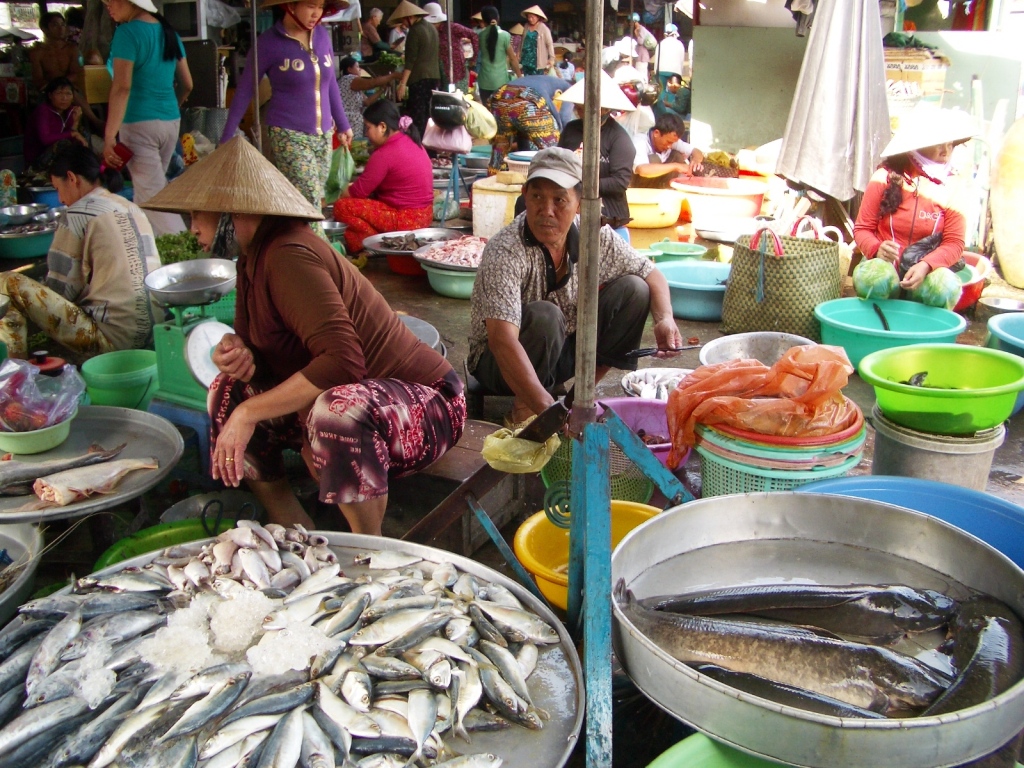
After perusing the floating market
we put in at the shore in order to take a stroll around the more conventional
type of market there, where a great variety of things were on sale – all kinds
of foodstuffs, textiles, hardware, etc. Markets the world over have that same
lively atmosphere; where eyes are both met and avoided; where vendors shout
melodiously and raucously; where prices are haggled and settled with swift
nods, handshakes, and fast produced and just as quickly concealed bills and
coins, emerging and disappearing in the blink of an eye. It’s a scene which is
common to all cultures, and one which has echoed down the ages and the
generations. Some markets though seem more timeless than others, and the lack
of ice or refrigeration at the fly-blown meat stalls make this one seem all the
more venerably old and unchanged despite all the brightly coloured plastic and motor
scooters. Even at this early hour of the morning it is still stiflingly hot in
the tropics.


Motoring up and down the river,
glimpsing quiet wooden go-downs with rusty corrugated iron roofs standing upon
stilts down sleepy inlets constantly reminded me of Joseph Conrad’s characters,
Kaspar Almayer and Jim Eng, idling out a veranda-bound existence in these
jungle-shrouded mangroves. This was exactly the kind of world I’d seen in
Michael Yamashita’s National Geographic photographs; the one I had
long pictured from reading Conrad’s novels, such as Almayer’s Folly (1895), An
Outcast of the Islands (1896), Lord
Jim (1900), and Victory (1905).
It was also reminiscent of Gavin Young’s wonderful travelogue, In Search of Conrad (1991), in which he
journeys around Southeast Asia attempting to trace Conrad’s old haunts from
Conrad’s days as a merchant seaman at the dwindling height of Europe’s global colonial
expansion. Young was a travel writer, friend of Wilfred Thesiger, and briefly
an MI6 agent, who had a long lasting affinity and attachment to Vietnam.
 |
| Young girls on their way to school, dressed in traditional white 'ao dai' |


It was still a fascination for me
to see the rhythms of riverine life continuing into the present, but in many
respects it is a world away from what it would have been in Conrad’s time. On
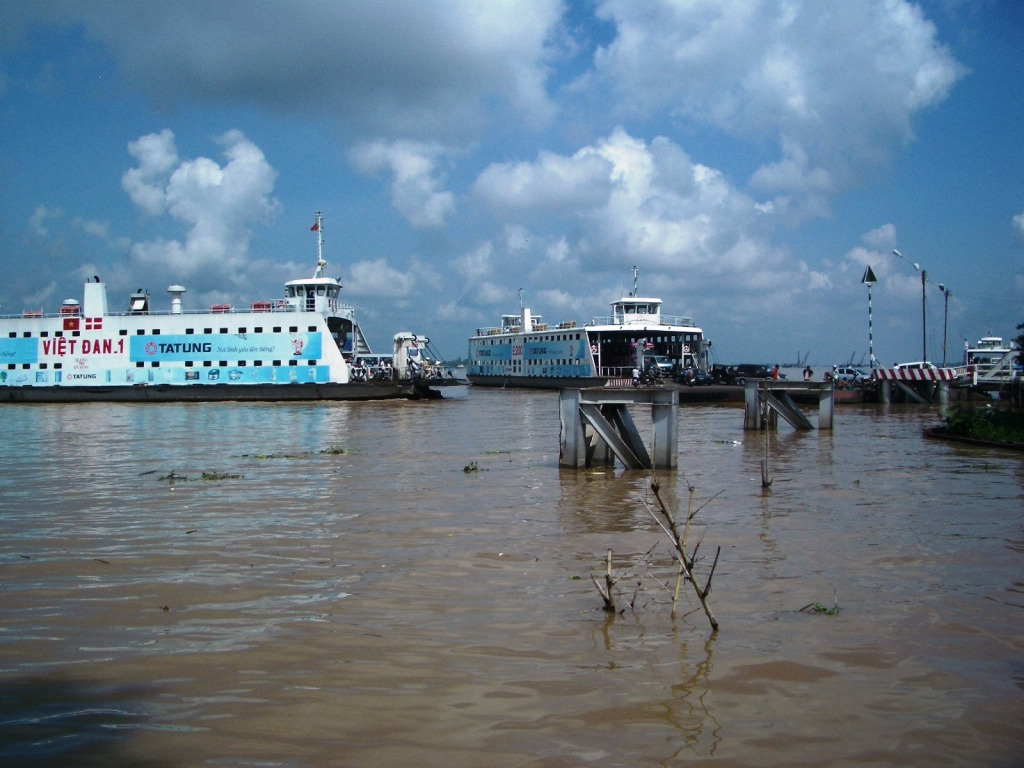
the horizon at the edge of the vast expanse of the Mekong I could see the two
concrete fingers of an enormous suspension bridge stretching out across the
rich muddy brown waters, soon to touch one another in the middle, like
Michelangelo’s hand of God reaching towards Adam’s on the ceiling of the
Sistine Chapel, except here the spark of life would eventually flow in the form
of commercial traffic, carrying large lorries and busloads of tourists in ever
increasing numbers. In 2007 a big accident in which 54 construction workers were
killed had halted construction for a while, but the building work had now
resumed (it opened the following year in April 2010), meaning that the days of
the large ferries operating along this stretch of the river were numbered.
Hence, while the inimitable rhythms of the River Mekong might well seem
timeless to those outsiders like me who pass over and along its powerful
waters, quietly slinking through the Vietnamese jungle like a giant hungry python,
it is not a place where time ever stands still for very long. And that perhaps
is exactly what makes the Mekong so alluring.

~


*The hopes and dreams of similar children today, living near to Long Xuyên on the Mekong in Vietnam, have been captured in a moving short film called "Down the Stream" (2015), directed by Mai Huyen Chi, which you can view here. It is both heart-warming and heart-breaking to listen to the very modest aspirations of these very small children who speak about the future lives they hope to lead when they grow up, if they can escape the poverty into which they have been born.
 |
| 'Down the Stream' (2015), directed by Mai Huyen Chi |
Also on 'Waymarks'
 |
| Let sleeping (hungry) pythons lie ... |


