Part
I – On Some Rumours Concerning the Untimely Death of the Blog
 According to a colleague of mine
the blog is dead.
According to a colleague of mine
the blog is dead.
“Whatever
happened to blogs, eh? You don’t hear anything about blogs anymore, do you? It
seems that bubble has well-and-truly burst. No one blogs anymore. Blogs are totally old hat
now!”
Hmmm …
“Au
contraire, Blackadder!”
… The ‘blogosphere’ is certainly still very much in
the rudest of healthinesses!
This little chat the other day set
me thinking about blogs and on-line reading habits. It seems I know many people
who are avid readers, and many of them find much of their reading matter
on-line. I certainly do. And so, taking my lead from the concept of the History Carnival, I thought I would write a brief résumé here of all the
blogs which I currently follow. I hope some of these might be of interest, dear
reader; and, similarly, I’d be very interested to hear of any recommendations
for intriguing websites or interesting blogs which you think I might not have
come across …

History Carnival is a good site to
start with, as it provides a monthly digest of the most interesting posts on
history blogs; it’s hosted by a different blogger each time, thereby helping to
keep the topics fresh and varied. Similarly Exeter University’s Imperial & Global Forum provides a weekly round-up of news articles found that week relating
to the themes of colonialism and empire. There are quite a few blogs which
focus on particular historical themes, for instance: Borderlands History – Port Towns & Urban Cultures, and The British Cold War. But there are also a
number of individual historians who write excellent blogs about their own teaching
and research, for instance: Joanne Bailey – Serena Dyer – Lucy Allen – Matt Houlbrook – Steven Gray – Dan Hicks – Richard Blakemore, and Caroline's Flickering Lamps. It was actually Rachel Leow’s
blog, A Historian’s Craft, which first prompted me to think – not just about starting
a blog myself, but also to think about returning to University to
pursue an MA in History, which has since very happily lead on to my current PhD
studies.

Naturally, many of the blogs I read
most regularly relate to the main areas of my research interests – mostly China and
Central Asia, and these tend to be a mix of history, archaeology, and anthropology;
for instance, blogs such as Sam van Schaik’s early Tibet, Justin Jacob’s
Foreign Explorers in Xinjiang, Geoff Barstow’s The Lost Yak, Imre Galambos’s
Chinese Manuscripts, and Llewelyn Morgan’s Lugubelinus, Hans van Roon’s Mongols, China & the Silk Road, Dan’s Tibeto-Logic, and Hannibal Taube’s Trans-Asia Trek
travelogue and China research blog.
Michael Woodhead’s In the Footsteps of Joseph Rock was another blog which inspired me to begin blogging, not least because part of my own research and travels similarly centred on creating “then & now” contrasts of old and modern photographs from the same part of the world.
Michael Woodhead’s In the Footsteps of Joseph Rock was another blog which inspired me to begin blogging, not least because part of my own research and travels similarly centred on creating “then & now” contrasts of old and modern photographs from the same part of the world.

Two interesting blogs with a wider and
often more current regional focus are East by Southeast and Steppe Dispatches.
A good notes and queries blog for anthropologists is Savage Minds.
And for Asian art topics there’s the Asian Art Blog, and Rachel Marsden’s Words.
A good notes and queries blog for anthropologists is Savage Minds.
And for Asian art topics there’s the Asian Art Blog, and Rachel Marsden’s Words.
More China-specific blogs which I’m
always checking-in on are the historian, Robert Bickers’ own personal blog,
Meena Vathyam’s Sikhs in Shanghai, Austin Dean’s The Licentiate’s Ledger, Sue
Ann Tay’s Shanghai Street Stories, Josepha Richard's Gardens of China, Covell Meysken's Everyday Life in Mao's China, as well as Frog in a Well, plus Visualising China, and, the Sinica Podcast.
More local to where I live, London
history blogs are also of great interest to me too. They can often be a spur to
turn off the computer and go exploring historical places much closer to home.
My main pick of these would be: A London Inheritance – The History of London –
Isle of Dog’s Life – A Rotherhithe Blog, and Running Past. Twitter, itself dubbed
as a kind of ‘micro-blogging’ site, has some great historical Tweeters;
History of Stokey and Cornish Bygone Times (admittedly located a bit further beyond the M25!)
are just two of many which regularly post wonderful historical photographs and
local history info about their respective areas. Ian Visits is also a good
source of occasionally obscure facts and interesting nuggets of London
Transport history, as well as being a good source of local events info too.
Paul Talling’s Derelict London is a mesmerising site for anyone like me with a
historical fascination for the aesthetics of urban decay.

Which (very loosely) leads on to another broader
category of interest for me – these are blogs which focus more on themes of
geography, nature, place, psycho-geography, and urbex (urban exploration), such
as: Paul Dobraszczyk’s rag-picking history, Julian Hoffman’s Notes from Near and Far, Stephen Rutt’s North Ron’ Diaries, Alex Cochrane’s adcochrane, Sara Evans’ website on travel and nature photography, Fraser MacDonald’s Modern Lives, Modern Landscapes, Laurence Mitchell's East of Elveden, Paul Scraton’s Under a Grey Sky and Traces of a Border, as well as Lines of Landscape, the Fife Psychogeographical Collective, and Atlas Obscura.
All great escapes from the everyday.
Cartography, old maps, antiquarian books,
and manuscripts always hook my interest – good examples which I follow are Cornelis J.
(Kees-Jan) Schilt’s Corpus Newtonicum, Erik Kwakkel’s medievalbooks, Jonathan
Crowe’s The Map Room, Nicholas Danforth’s The Afternoon Map, plus Melville’s Marginalia, and, the Public Domain Review.

A number of institution-based blogs
regularly post a lot of interesting articles about their work. The British
Library has a number of first rate blogs – such as, Endangered Archives – Asian & African Studies – Untold Lives – Medieval Manuscripts and Maps & Views. There’s also the excellent International Dunhuang Project. SOAS also field a
number of good blogs – such as their Special Collections Archive and South Asia Notes. The South Asia Archive & Library Group brings together a lot info relating to these areas too. Other notable sites include, the Senate House Library blog – The Royal Asiatic Society blog – The Institute of Historical Research blog, as well
as, Translating Cultures, and The Himalayas & Beyond. The list goes on …
… and yet, my colleague reckons
that blogging is dead?
Yes. The blog is dead. Long live the blog!

Part
II – Re: Matters of Infinitely Multiplying Reading Matter
 As anyone regularly reading this blog will no doubt have long since realised, books are a substantial
cornerstone of my world. I spend a lot of time in libraries and bookshops. I
often find myself heaving bags of these weighty things from place to place. My
flat is filled with books, and it’s never long before any empty surface therein
swiftly becomes the locus in quo for
a towering pile of new tomes to magically manifest. Indeed, I very much feel
that a life without books would be no life at all.
As anyone regularly reading this blog will no doubt have long since realised, books are a substantial
cornerstone of my world. I spend a lot of time in libraries and bookshops. I
often find myself heaving bags of these weighty things from place to place. My
flat is filled with books, and it’s never long before any empty surface therein
swiftly becomes the locus in quo for
a towering pile of new tomes to magically manifest. Indeed, I very much feel
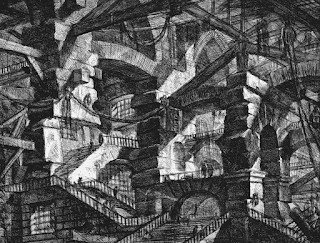
that a life without books would be no life at all.So it’s perhaps no surprise that I often write about the books I’ve read here (and elsewhere too), but, as an avid reader, books are not my only source of reading material. Naturally, the internet is now the largest public library open to plunder and I spend a lot of time doing just that – but it’s easy to get lost in this Borgesian labyrinth, and so, like Theseus, its best to have a strategy to help navigate it. My on-line reading habits have evolved over time. I now have a set of favourite sites on the web which act as portals or siphons respectively opening up and channelling web content which might be of interest to me and my studies – Twitter and 3 Quarks Daily are two such sources of endless supply.
Many of the on-line archives and
research forums I follow I’ve bookmarked using my Bundlr page. I’ve also
bookmarked a number of blogs there too, however, I generally use the RSS Feed in
my internet browser to keep up-to-date with notifications of new content being
posted. Perhaps (for me at least) the most invaluable tool on the web nowadays
to keep connected and up-to-date is Twitter. I find a lot of bloggers and
academics use Twitter – it’s a brilliant way to share links to new reading
matter with colleagues and friends. It’s also a great way to connect with other
readers, writers, and researchers. I’ve got to know some very nice people
through Twitter, and, occasionally, with a fair few of them (several of whom I’ve
mentioned above) the conversation in cyberspace has happily transferred over
into the real world and continued over a cup of coffee, or a pint of beer or two!
 Twitter really
highlights the connectivity and sheer speed of the internet age. For instance, late one night,
whilst I was working hard on an essay towards my MA, I thought I’d take a break
from writing by making a cup of tea and having a quick peruse to see what was
happening on Twitter. By an astonishing coincidence, one of
the first tweets which popped up on the screen was posted by an academic (whom I
follow) with a link to a recent interview he’d given. I clicked on the link and
as I read the interview I realised it was highly relevant to one of the points
I was at that very moment making in my paper and therefore it was something
which I should definitely cite. So, flipping back to my draft essay, I added
the citation there and then. It was only a day or so later, during a final
proof-read, that I noticed the “access date” I’d given for when I’d read the interview
preceded the actual “publication date” of the piece by a single day – after a
moment’s puzzlement I realised this was because the website on which the
interview was featured was based in Australia. My late night reading of the
piece – only moments after it had been uploaded as it turned out – meant that I
was reading an interview published on the other side of midnight on the other
side of the world – hence the inadvertent and seemingly impossible feat of
academic time-travel! … Research rarely gets any more up-to-date than that!
Twitter really
highlights the connectivity and sheer speed of the internet age. For instance, late one night,
whilst I was working hard on an essay towards my MA, I thought I’d take a break
from writing by making a cup of tea and having a quick peruse to see what was
happening on Twitter. By an astonishing coincidence, one of
the first tweets which popped up on the screen was posted by an academic (whom I
follow) with a link to a recent interview he’d given. I clicked on the link and
as I read the interview I realised it was highly relevant to one of the points
I was at that very moment making in my paper and therefore it was something
which I should definitely cite. So, flipping back to my draft essay, I added
the citation there and then. It was only a day or so later, during a final
proof-read, that I noticed the “access date” I’d given for when I’d read the interview
preceded the actual “publication date” of the piece by a single day – after a
moment’s puzzlement I realised this was because the website on which the
interview was featured was based in Australia. My late night reading of the
piece – only moments after it had been uploaded as it turned out – meant that I
was reading an interview published on the other side of midnight on the other
side of the world – hence the inadvertent and seemingly impossible feat of
academic time-travel! … Research rarely gets any more up-to-date than that!
 Twitter really
highlights the connectivity and sheer speed of the internet age. For instance, late one night,
whilst I was working hard on an essay towards my MA, I thought I’d take a break
from writing by making a cup of tea and having a quick peruse to see what was
happening on Twitter. By an astonishing coincidence, one of
the first tweets which popped up on the screen was posted by an academic (whom I
follow) with a link to a recent interview he’d given. I clicked on the link and
as I read the interview I realised it was highly relevant to one of the points
I was at that very moment making in my paper and therefore it was something
which I should definitely cite. So, flipping back to my draft essay, I added
the citation there and then. It was only a day or so later, during a final
proof-read, that I noticed the “access date” I’d given for when I’d read the interview
preceded the actual “publication date” of the piece by a single day – after a
moment’s puzzlement I realised this was because the website on which the
interview was featured was based in Australia. My late night reading of the
piece – only moments after it had been uploaded as it turned out – meant that I
was reading an interview published on the other side of midnight on the other
side of the world – hence the inadvertent and seemingly impossible feat of
academic time-travel! … Research rarely gets any more up-to-date than that!
Twitter really
highlights the connectivity and sheer speed of the internet age. For instance, late one night,
whilst I was working hard on an essay towards my MA, I thought I’d take a break
from writing by making a cup of tea and having a quick peruse to see what was
happening on Twitter. By an astonishing coincidence, one of
the first tweets which popped up on the screen was posted by an academic (whom I
follow) with a link to a recent interview he’d given. I clicked on the link and
as I read the interview I realised it was highly relevant to one of the points
I was at that very moment making in my paper and therefore it was something
which I should definitely cite. So, flipping back to my draft essay, I added
the citation there and then. It was only a day or so later, during a final
proof-read, that I noticed the “access date” I’d given for when I’d read the interview
preceded the actual “publication date” of the piece by a single day – after a
moment’s puzzlement I realised this was because the website on which the
interview was featured was based in Australia. My late night reading of the
piece – only moments after it had been uploaded as it turned out – meant that I
was reading an interview published on the other side of midnight on the other
side of the world – hence the inadvertent and seemingly impossible feat of
academic time-travel! … Research rarely gets any more up-to-date than that!
I don’t (yet) own a Kindle (and, to
be honest, nor do I really want to own one), but I do own a tablet PC (which,
in many ways, is perhaps something of sorts far beyond a simple Kindle!) And ... I'll happily admit that my
tablet PC is invaluable. I read a lot of academic journal articles as
part of my PhD research, and many of these I access and download electronically,
via JSTOR or via Birkbeck College eLibrary. On the whole I do prefer to
print-off a paper copy of these, as I find paper-versions are much easier on
the eye when reading, rather than staring for long concentrated periods at a screen,
plus you can scribble notes and marginalia more easily on a paper copy than on
a PDF, but there’s a limit to the resulting piles of paper which can thereby
accrue alongside the already teetering towers of books! … Consequently, the
tablet PC is actually the best way to store and refer to these types of text (plus
it is possible to highlight and
annotate passages using this system too).
When I was still in High School I remember reading an old Isaac Asimov ‘David Starr Space Ranger’ story in which a particular character (a hermit-like chap living alone on a asteroid, I think) was described as owning a vast library of “books on tape”. Even though this story was written (and I too was reading it) in a pre-digital era, I couldn’t really picture what such a library might have looked like – the closest thing, I supposed, was perhaps a library of video cassettes. Now I often find myself thinking back to my younger self puzzling over that mental picture from Asimov’s story when, simply sliding my finger lightly across the touch screen of my tablet PC, I flip through these endless rows of neat little PDFs ... It may not quite be Space: 1999 yet, but the world has certainly changed rather fast in some respects!
When I was still in High School I remember reading an old Isaac Asimov ‘David Starr Space Ranger’ story in which a particular character (a hermit-like chap living alone on a asteroid, I think) was described as owning a vast library of “books on tape”. Even though this story was written (and I too was reading it) in a pre-digital era, I couldn’t really picture what such a library might have looked like – the closest thing, I supposed, was perhaps a library of video cassettes. Now I often find myself thinking back to my younger self puzzling over that mental picture from Asimov’s story when, simply sliding my finger lightly across the touch screen of my tablet PC, I flip through these endless rows of neat little PDFs ... It may not quite be Space: 1999 yet, but the world has certainly changed rather fast in some respects!
 The internet as a global platform
seemingly without boundaries (for the most part) has definitely transformed both the
means and extent of dissemination and sharing of information. It’s easy
to see why the present time period is best described as the 'new information age'
– this is an era which is revolutionising the way we live, enhancing global
communication and connectivity through immediacy; reducing time and distance, and making a global
outlook an increasingly normal part of our day-to-day lives. It’s easy to
overlook how truly remarkable this transformation
actually is.
The internet as a global platform
seemingly without boundaries (for the most part) has definitely transformed both the
means and extent of dissemination and sharing of information. It’s easy
to see why the present time period is best described as the 'new information age'
– this is an era which is revolutionising the way we live, enhancing global
communication and connectivity through immediacy; reducing time and distance, and making a global
outlook an increasingly normal part of our day-to-day lives. It’s easy to
overlook how truly remarkable this transformation
actually is.Some people seem to think it’s turning us in on ourselves, with our "introverted and narcissistic" Facebook updates, our selfie-sticks, Instagram pics, and personal blogs – but I don’t agree, if the internet is a mirror I think it’s a parabolic one (an ‘eccentric parabola’, perhaps?), projecting as much as reflecting ... Maybe, living in the here-and-now, as we do, precludes us from realising this? – Perhaps we’re simply too close to see the remarkable nature of all these new connections we are forging? ... Our resources nowadays seem to be an ever broadening horizon. Certainly, looking back, I can’t begin to fathom how I managed to even begin – let alone complete – my first degree in the then decidedly more muffled pre-internet age.

P.S. - I've just noticed a near cosmic alignment - this post's time stamp almost forms a palindrome: 15:20 6/6/2015.


