Showing posts with label Nepal. Show all posts

30 December 2024

Exploring "Other Everests" - One Mountain, Many Worlds


Probably the highlight of my year was receiving my copy of Other Everests: One Mountain, Many Worlds (MUP, 2024). This book is the culmination of one of the most interesting and enjoyable academic ventures I’ve ever been involved with. I feel very fortunate to have been able to add a small contribution to this collection in the form of an essay which helped me to find a focus and a framework for an idea which I had long been mulling over – the ‘Lost Horizon’ idea of the Himalaya as a home for imaginative geographies, utopian projections, and the realities upon which such notions where actually grounded. Now, having read the finished book in its entirety, I feel absolutely in awe of the company amongst which my chapter is collected. Hats off to my fellow Other Everests authors and the editors, who have all done a magnificent job in creating such a wide-ranging, thoughtful, thought-provoking, insightful, and immaculately edited collection.


Given my involvement with the project and the fact that I’ve authored one of the chapters, it would be highly inappropriate for me to attempt to write an in-depth review of the book here on my own blog. So instead, I have collated the abstracts for each chapter (see below), as these give a very good overview of what the book is all about – summarising its aims, its intentions, and the conversations and continuing work which it hopes to inspire. The book’s introductory essay, written by Paul Gilchrist, Peter H. Hansen and Jonathan Westaway, also does this in a much more connected, cohesive and coherent way, so I highly recommend beginning with this – it can be accessed and either read on-line or downloaded for FREE (as can all of the book’s chapters) from the publisher’s website here. I very much hope that libraries, academic and non-academic alike, will purchase physical copies of the book – so do please encourage any librarians you might know to consider buying a copy or two for their institutions!


Just to give a little extra background: my own involvement with the Other Everests research network began back in the summer of 2022, when I attended a two-day symposium held at the Royal Geographical Society (RGS) in London. This was a really inspirational meeting which aimed at opening up hitherto little-known, unexplored or under-explored perspectives on Mount Everest/Chomolungma. You can read my thoughts and reflections on this genuinely horizon-expanding gathering here, and you can also hear some of the fascinating keynote lectures which were given at that event via the Other Everests webpage. I also wrote a review of an exhibition which was held at the RGS entitled Everest through the Lens in 2022-2023; this exhibition used archival material, early cinema documentary film, and artefacts associated with the Everest expeditions of the 1920s to highlight some of the ‘hidden histories’ of Everest from both Western and Indigenous perspectives. You can read my review here on this blog, or download a PDF of it from my personal website.


Lastly, there is an excellent discussion with editors, Jonathan Westaway and Peter H. Hansen, and essay contributor, Sarah Pickman, who very eloquently elucidate more about the Other Everests book and the themes it explores on The Alpinist magazine’s podcast, which you can listen to here.


Before closing, I hope it’s not too out of place for me to add a note here that my chapter for the Other Everests book was in fact only one half of a linked undertaking for me. An undertaking which I like to think of as my ‘Himalaya and Hollywood’ project. I wrote my Other Everests chapter in conjunction with another book chapter, which I hope will be published in a second edited collection in the coming year or so (I’ll post updates on the schedule for this as and when I know more about it). This second essay is also concerned with Western perceptions and depictions of the Himalaya on film, but seen from a slightly different angle to that looked at in Other Everests, having grown out of a blog post which I wrote a few years ago, and which you can read here. This future book chapter gives a much more detailed and academic analysis than the original blog post of the same topic of mountains and mysticism explored in my Other Everests chapter ... and, this time, also of monsters! – so keep ‘em peeled and watch this space – But, in the meantime, I very much hope you will enjoy exploring the chapters of Other Everests, as outlined below:


 Chapter Abstracts

Other Everests: One Mountain, Many Worlds (MUP, 2024) attempts to clear a space to engage the many worlds that share the same mountain, the multiple ways of being-in-the world, ‘a world where many worlds fit’. The book’s introductory chapter highlights some of these ‘worlds’ and overlapping themes in Everest’s many names, nations, genders, tourists, climates, and stories. Throughout this volume, the international and interdisciplinary array of contributors reactivate old and new archives, engage with multimedia and live performances, and participate in historical or ethnographic fieldwork. They shed light on the different ways of being in relationship with the mountain and how these are navigated by climbers and high-altitude workers alike, from ritual ceremonies to the mountain’s immovable goddess, through to contemporary digital practices as global adventure tourists and guides curate their Everest experiences. The authors in the volume contribute to a plurality of new histories and perspectives.


Chapter 1: The immovable goddess: The long life of Miyo Lang Sangma, by Ruth Gamble.

In the 1850s, Andrew Waugh, head of the Great Trigonometric Survey of India, named the highest peak in the central Himalayas after his mentor, George Everest. As Ruth Gamble describes in this chapter, Waugh’s decision obscured the mountain’s centuries-long association with Chomolungma, also known as Miyo Langsangma, a deity revered by the Tibetans and Sherpas who lived near it. By tracing this goddess’s history back through the centuries, Gamble places the goddess in the wider contexts of Himalayan sacred geography, demonstrating the role she and her sisters, the Tseringma Chenga (Five Sisters of Long Life), played in the region’s cultural history and the life stories of two of the Himalaya’s most famous religious figures, Guru Rinpoche (semi-mythical, eighth century) and Milarepa (eleventh century). By tracing this history, Gamble shows that the British claims that there were no local names for the mountain are incorrect, and the Tibetan and Sherpa communities have continued to venerate the goddess despite commercial imperatives to refer to it as Everest and Chinese and Nepali attempts to recast the mountain as nationalist symbols.


Chapter 2: Naming Mount Everest: Mountain cartography and languages of exonymy, by Felix de Montety.

Felix de Montety examines the nineteenth- and twentieth-century naming of Mount Everest from the perspective of critical place-name studies. In 1856, the surveyor Andrew Waugh proposed this place name for the world’s highest peak as a tribute to his predecessor, George Everest. Initial debates between Waugh and Brian Hodgson, a naturalist and linguist, echoed in later controversies over exonomy (the use of non-local place names by outsiders) in mountain toponymy and cartography. This chapter looks at the role of maps, instruments, philology, publications, and archives from geographical and mountaineering societies to examine arguments over proposed place names, including Mount Everest, Deodunga, Gaurisankar, or Chomolangma. Since the mid-twentieth century, China and Nepal have embraced Qomolangma or Sagarmatha as official names despite the enduring presence of Mount Everest as a mountain exonym in postcolonial societies. Mountain toponymy is a case study in modern mountaineering’s limited interest in local knowledge and blindness to political issues in climbing areas. The history of ‘Mount Everest’ as the product of Himalayan surveying, mapping, and mountaineering shows that place names can change and reminds us that alternatives exist and can and should be debated.


Chapter 3: Re-activating the expeditionary archive, by Felix Driver.

The centenary of the Everest expeditions offers an opportunity to consider the role archival collections have played and could play in histories of exploration and mountaineering. The history of these expeditions as told in word and image during the 1920s has weighed heavily on subsequent re-tellings across a variety of media. Yet the collections they generated have the potential to inform radically different versions of this history, foregrounding the role of colonial infrastructure, expeditionary labour, and Indigenous agency. To realise this potential, Felix Driver argues, requires developing an expanded vision of the expeditionary archive which recognises its multiple forms and affordances. This chapter explores the ways in which the story of the early Everest expeditions has been told and might be re-told using materials in the Royal Geographical Society’s collection, focusing particularly on the avalanche which killed seven Indigenous porters in 1922. The capacity of expeditionary archives to surprise and challenge, move and inspire – indeed, their wider significance as world heritage – depends partly on what they contain but also on the way they are approached; the questions which are asked of them; the methods used to research them; and the means by which they are shared more widely.


Chapter 4: The benefit of chocolate and cold tea: Equipping early British Everest expeditions, by Sarah Pickman.

What can packing lists and receipts tell us about the history of mountaineering on Everest? Sarah Pickman explores this question by examining the archives of the British Mount Everest expeditions of the 1920s. The materials used to outfit the expeditions reveal the social worlds that produced the early Everest climbers and the climbers' expectations for life on the mountain. British Everest climbers brought many items that might seem superfluous to the modern eye – from decadent foods to evening clothes – but that reveal Everest's connections to colonialism, the growth of Western consumer culture and advertising, British beliefs about class and status, and assumptions about expedition labour. What they carried also demonstrates that the idea of 'comfort' was part and parcel of expeditions to even the most extreme environments on earth. By taking seriously the quotidian gear and provisions carried on the 1921, 1922, and 1924 Everest expeditions, this chapter demonstrates that the study of material culture can be a fruitful approach for telling new stories about the world's highest mountain.


Chapter 5: Far-away frontiers and spiritual sanctuaries: Occidental escapism in the high Himalaya, by Tim Chamberlain.

Tim Chamberlain examines the allure which the Himalaya has long exerted upon Western adventurers, both in fiction and in real life. Drawing upon contemporary interest in the early British expeditions to climb Everest, this chapter shows how two novels blurred the line between imagination and authenticity, playing upon themes of escape and adventure. In response, travelogues fed back into Western notions concerning the remoteness of the Himalaya. Chamberlain demonstrates how networks of mobility for the Indigenous guides supporting Western travellers spanned the full extent of the Himalayan massif. Though portrayed as a distant and inaccessible region for Westerners, this interconnected landscape was, in fact, already well-known and consciously mapped by local polities. This network of knowledgeable and experienced Indigenes was essential for the travellers who wished to fulfil their aspirations ‘to step off the map’ and ‘escape modern civilisation’. Their search for a notionally ‘unexplored’ Shangri-La thereby created an abiding leitmotif for Himalayan exploration in the Western imagination.


Chapter 6: Seeing histories from the margins: An Indigenous labour force on Everest, 1921–53, by Jayeeta Sharma.

This chapter explores ‘ways of seeing’ the labouring infrastructure of the British Mount Everest expeditions from 1921 to 1953. Jayeeta Sharma juxtaposes photographs of mountaineering labour with first-person narratives from British mountaineers such as General C.G. Bruce and Indigenous Sherpa mountaineers including Ang Tharkay and Tenzing Norgay. A selection of first-person narratives from imperial and Indigenous mountaineers in dialogue with expedition photographs becomes a way to make visible and frame Indigenous histories from the margins of the British Empire. The sentient labour of Indigenous animals and humans provided the indispensable infrastructure for Euro-American mountaineers to realise their ambitions on Everest. The Mount Everest expeditions also relied on domestic infrastructures of Indigenous labour in places well beyond the mountain. The contribution of Sherpa women as well as men may be hidden in archives but is still visible in the margins of history.


Chapter 7: Women on Everest: A summit beyond, by Jenny Hall.

In 1975, Japanese mountaineer Junko Tabei became the first woman to summit Everest and was celebrated as a symbol of women’s social progress. Since then, over seven hundred women have followed in Junko Tabei’s footsteps on Everest, representing over 11 per cent of all summiteers. Asian women played an important and pioneering role in these developments. Yet the representation of high-altitude mountaineering in popular culture still tells the story of adventure as white male middle-class masculinity that stubbornly resists diversity, as shown by Julie Rak’s False Summit (2021). This chapter explores how women navigated multi-dimensional inequalities concerning race, gender, and class through pioneering, women-centred approaches to high-altitude mountaineering. The analysis of memoirs and expedition accounts of and by women from the global South offers a critical reappraisal of women’s contribution to climbing Everest. Asian women built transnational support networks to tackle intersecting challenges through women-centred practices, infrastructures, and camaraderie. By showcasing the women-centred approaches of these Asian women pioneers, this chapter aims to diversify and balance the representation of mountaineering adventure as a shared cultural heritage.


Chapter 8: Rewriting Irvine into Everest: Audrey Salkeld and Julie Summers, by Anna Saroldi.

Anna Saroldi focuses on the role of women in the writing and transmission of mountaineering histories. The chapter focuses on the example of Andrew Comyn (Sandy) Irvine, who died on Everest in 1924 when 22 years old and while attempting a summit push with George Mallory. Saroldi highlights how Irvine had been sidelined in accounts of the British Everest expeditions and portrayed as a passive figure. Thanks to historians Audrey Salkeld and Julie Summers, Sandy Irvine has been recentred and his agency highlighted in more recent accounts. Audrey Salkeld (1936–2023) was also notable in pioneering the role of ‘expedition historian’ when she joined the 1986 Everest expedition led by Tom Holzel with the specific goal of finding Mallory’s and Irvine’s bodies. The presence and authority of women historians represents an important intervention in an environment such as mountaineering that is dominated by men in terms of both practice and ideology. Finally, Saroldi stresses the importance of choral and multivocal methodological approaches that go beyond the figure of the solitary male and white hero in favour of more inclusive and diverse portrayals of mountaineering history.


Chapter 9: Expecting hypermasculinity from a woman mountaineer: Wanda Rutkiewicz’s ascent of Everest, by Agnieszka Irena Kaczmarek.

Agnieszka I. Kaczmarek examines expectations of hypermasculinity when Wanda Rutkiewicz broke gender barriers in high-altitude mountaineering as the first Polish mountaineer and first European woman to scale Mount Everest in 1978. The chapter discusses why male team members in the German–French Mount Everest expedition diminished her achievements and held Rutkiewicz to high expectations of hypermasculinity during the climb. Utterly determined to stand on top, Rutkiewicz did exhibit hypermasculine patterns of behaviour while climbing and had similar expectations for Marianne Walter, a German woman climber whom Rutkiewicz criticised for her dependence on her husband and lack of self-reliance. Tough on herself and her companions, Rutkiewicz also commented on her own fear and loneliness. Rutkiewicz oscillated between behaviours and attitudes too often regarded as embodiments of either femininity or masculinity. The chapter presents Rutkiewicz as a woman who embodied a mountaineer with a hybrid identity, not binary, blending attributes of gender as multiple, not just one.


Chapter 10: The ‘Slovenian’ Everest 1979: A small nation and the highest mountain in the world, by Peter Mikša & Matija Zorn.

Peter Mikša and Matija Zorn focus on the 1979 Yugoslav Everest expedition and the environment in which Yugoslav and Slovenian mountaineering operated in the 1970s. On 13 May 1979, Andrej Štremfelj and Nejc Zaplotnik became the first Slovenians (and Yugoslavs) to climb Mount Everest. They reached the summit after forty-five days of climbing the challenging West Ridge Direct, the most difficult route on Everest to that time. The ascent represented the success of a twenty-five-strong Yugoslav team, of whom twenty-one were Slovenes. The majority of Yugoslav ascents before the breakup of Yugoslavia were made by Slovenian mountaineers. Critical to their success on Everest was the wealth of experience gained from a series of past Yugoslav Alpinist Himalayan Expeditions with several ascents of 8,000-metre peaks. Since 1979, Slovenian ascents of Everest have included three noteworthy achievements: the first married couple, an ascent without supplemental oxygen, and the first continuous ski descent from the summit. Another legacy of the Slovenian mountaineers in 1979 was the founding a climbing school for Nepalis at Manang, Nepal.


Chapter 11: Reclaiming Everest: Discontents, disasters, and the making of a Nepali mountain, by Ian Bellows.

Mount Everest endured a series of high-profile disasters and disruptive incidents during the 2010s, including a violent 2013 confrontation between high-altitude workers and professional mountaineers followed by the deadly 2014 Khumbu Icefall avalanche which sparked protests that ended the climbing season. In both cases, demands by mostly Indigenous high-altitude workers for greater rights and recognition brought renewed scrutiny to the structural inequities of the Everest industry. This chapter situates the tumultuous 2013 and 2014 Everest seasons within a century-long struggle for respect and better working conditions on the world’s highest mountains. From strikes and labour organising during the expeditionary period to the increasing prominence of Nepali expedition operators, guides, and alpinists on Everest and in Himalayan mountaineering over the past decade, acts of resistance and reclamation have marked critical junctures in Everest’s history. While Nepali alpinists have achieved global recognition for climbing accomplishments and Nepal-based companies have claimed a growing share of the commercial mountaineering market, this chapter argues that recent transformations have left the foundational mountaineering modality and moral economy of Everest relatively unchanged. This raises critical questions about what it means to ‘reclaim’ a mountain like Everest and the long-term sustainability of the Himalayan mountaineering industry.


Chapter 12: Sherpa’s Everest and expedition conglomerate, by Young Hoon Oh.

Complexly patterned hierarchies dictate the various roles and ideal behaviours of Sherpa and other Nepali employees in Himalayan mountaineering expeditions. Drawing on ethnographic research throughout the 2010s, Young Hoon Oh considers Sherpas’ perspectives on the industrial practices in mountaineering expeditions to Himalayan giants such as Mount Everest. The workforce on Himalayan expeditions has been diversely stratified and pyramidally governed to uphold what Oh calls expedition conglomerate – a mega-sized expedition that efficiently supports large numbers of client-members and their pleasurable Himalayan experiences. The workforce ordinarily consists of a variety of positions including team guide, base camp manager, climbing Sherpa, trekking Sherpa, kitchen staff, and porters. This chapter offers observations of climbing Sherpas’ wage structure, dissecting the multiple and often irregular income sources, including daily wage, equipment fee, carry bonus, summit bonus, tip, and significant payments from by-work. A brief analysis of the patterns of these expeditionary practices sheds light on the transformative nature of the guiding industry, which is, Oh concludes, a function of colonial legacies and unchecked neoliberalism rampant on the Himalayan slopes.


Chapter 13: The numbers game on Mount Everest: New ‘lows’ on the world’s highest mountain, by Pradeep Bashyal & Ankit Babu Adhikari.

Mountaineering traffic on Everest frequently breaks records and the numbers game has several elements. Increasing numbers of climbers result in more employment opportunities in adventure tourism and rising revenue for the government of Nepal. The Nepali Ministry of Tourism charges a summit fee of USD 11,000 for a permit to climb Everest. Climbing permits and tourism revenues contribute significantly to Nepal’s economy. Growth of tourism on Everest has also transformed the lives of Sherpas and other local communities. The shift to a commercial business model that promotes adventure tourism on Everest has led to over-tourism above 8,000 metres – increasing risks of overcrowding, injury, and death. Commercial outfitters de-emphasise these risks when seeking customers and increasingly offer a range of commercial packages based on different consumer price points. High-end adventure travel companies in the 2020s offer luxury expeditions, requiring Sherpas to carry unnecessary Western consumer items to higher camps, significantly increasing the associated risks. Government regulation has failed to manage these crises of overconsumption on Everest.


Chapter 14: Digital media on Everest: Practices, imaginations, and futures, by Jolynna Sinanan.

Everest has always been mediatised and its appeal as an idea has existed historically in part through technologies of visual cultures. Twenty-first-century tourist experiences and mobile livelihoods also depend on configurations of fixed, dispersed, and mobile digital infrastructures. Drawing on fieldwork in the Solukhumbu region of Nepal with guides, porters, and tourists, Jolynna Sinanan argues that digital practices create gradients of visibility in visual narratives of Everest. The production and circulation of images through digital technologies shape how tourists imagine and experience Everest. At the same time, the digital practices of guides and porters can be strategies for livelihoods and aspirations for recognition and intergenerational mobility that have the potential to create alternative Everest narratives based on regional knowledge and experiences of work. Guides and porters in Everest tourism were formerly Sherpa but are increasingly from Tamang and Rai ethnic groups, which have been historically at the margins of Nepali society. Sinanan interrogates the relationships of power in representing Everest through contemporary digital practices and the tensions between the valorisation of regional knowledge and neocolonial imaginations.


Chapter 15: Thin ice, thin air, by Yvonne Reddick.

In this creative piece, Yvonne Reddick visits the melting Khumbu Glacier at Everest Base Camp and reflects on climate change. She meets trekking guide Hem Raj Dharmala and asks him about the climate change impacts he has seen in Nepal. Global heating is leading to increased avalanche activity, disappearing lakes, and landslides in the region. However, new areas are also becoming available for Nepali farmers to grow crops. She reflects on her own conflicted position, as a concerned citizen committed to understanding climate justice, while still benefiting from fossil-fuelled transport that contributes to the problem. What are the trade-offs between tourism and thinning ice at the world’s ‘third pole’? What do the dwindling glaciers mean for mountain communities and mountaineers? With a nod to Jon Krakauer’s Everest classic Into Thin Air, Yvonne Reddick looks at the process of glacial sublimation whereby high-altitude glaciers change state directly from solid to vapour – literally vanishing into thin air.


Chapter 16: Everests on stage: Contemporary theatre’s contribution to decolonising the mountain, by Jonathan Pitches.

What can theatre offer the cultural record of Everest that has not already been expressed in literature, music, photography, or film? Less visible than these media, the dramatic record of Everest on stage is nevertheless rich, extensive, and long-lived. In this chapter, Jonathan Pitches focuses on the staging of Everest in the 2010s and early 2020s, considering three performances to establish what they reveal about the changing significance of Everest in the contemporary world. Drawing on insights from newly conducted interviews with four artists (Matt Kambic, Carmen Nasr, Gary Winters, and Gregg Whelan), the selection of recent performance work serves as a paradigm of the ways in which Western contemporary theatre has engaged with the history, culture, and geopolitics of the world’s highest mountain. Each of the live acts and performances uses varied means to render Everest’s cultural complexity, contradictory reception, and historical density with a lightness of touch which belies their rigour and import.


31 October 2023

"Everest Through The Lens" - Exhibition Review


Climbing Mount Everest. Under the auspices of the Mt. Everest Committee: the cinematograph record of the Mount Everest Expedition of 1922. EE/6/5/60 (RGS-IBG Collection)

Exhibition Review: Everest through the lens (Royal Geographical Society (with IBG), 1 Kensington Gore, London, SW7 2AR, UK: 5 October 2022-20 January 2023) - this review was originally written for the Other Everests Research Network

NB - the exhibition is currently back on display at the RGS from 20 January 2025 - 15 April 2025 (10.00am-5.00pm, Monday-Friday), free entry. Click here for more information.


Everest through the lens was an exhibition marking the centenary of the first two British attempts to climb the world’s highest mountain in 1922 and 1924. It examined the expeditions as seen through the lens of official expedition cinematographer, Captain John Noel. Focussing on the two films he made, Climbing Mount Everest (1922) and The Epic of Everest (1924), the exhibition set out ‘to unpick the uncomfortable and complex social, racial and geopolitical dynamics that shaped the expeditions – from their beginning to enduring legacy.’ Utilising a range of photographic and documentary sources, as well as a handful of well-chosen objects – such as a kinomatograph camera, similar to the one Noel used at high altitude, and Noel’s own Remington portable typewriter – exhibition visitors were guided through the various stages of the two expeditions, from their meticulous preparation, through their actual execution, to their final presentation in both print and film media.


As a documentary filmmaker, Noel’s lens was far from an objective one. The narrative of both films gives a distinctly colonialist view of the ‘heroic’ exploits of the British climbers, whilst the far larger entourage of local porters and other indigenous labourers who were key to enabling the endeavour are lost somewhere in the flickering side-lines, obscured by the simultaneous glare of the white snows and the reflected imperial glory bestowed upon the films’ British protagonists. Viewing the expeditions in the context of their times, this was a period when empires and nations vied to best one another in epic feats of exploration in harsh and extreme environments. Notably the British had lost out in the races to be the first to reach the North and South Poles, hence the summit of the world’s highest mountain – or the ‘Third Pole’ as it was then dubbed – represented a last chance at attaining pre-eminence. Together, the Royal Geographical Society and the Alpine Club formed the Mount Everest Committee, which tasked itself with recruiting a team of elite mountaineers and geographers. Naturally these men were all British born and bred, privately educated and recruited through a network of mutual contacts. Letters and medical appraisals show that social considerations of class and military background counted as much as aptitude and experience in mountaineering. We are told that George Finch, as an Australian, was a lone exception to this rule, but that consequently he ‘was looked down on by some team members.’


A far more overtly condescending view was expressed with regard to the indigenous communities whom the expeditions encountered as they made their way through Tibet. An intertitle card from one of Noel’s films gives a clear example, stating that: ‘The men and women exist from the cradle to the stone slab, on which their dead bodies are hacked to pieces, without a wash the whole of their lives.’ The British expedition members were genuinely fascinated by the cultures they encountered in the Himalaya. Noel filmed scenes described in another intertitle as: ‘the weird and fantastic devil dances at the sacred monastery of the Rongbuk.’ A Tibetan cymbal brought back by the expedition leader, Brigadier-General Charles Bruce in 1922, included in the exhibition, shows how the British climbers were particularly struck by Tibetan music which must have seemed very different to their unaccustomed ears. Climber and surgeon, Howard Somervell transcribed Tibetan folk songs into Western musical notation, and Noel later had bands perform this music as an evocative accompaniment to the screenings of his silent films.


Trailer for Noel's "The Epic of Everest" (BFI)
              

Social hierarchies shaped the expeditions. Base Camp was effectively a small village, run by the British along familiar colonial lines, with clear demarcations according to social, racial and class considerations. The selection process for local porters may have been less careful to note down details, but everyone recruited – ‘from bootmakers to botanists’ – had a role with set expectations and was renumerated accordingly. Ranked highest in this hierarchy were the high-altitude porters, who were very skilled and often more adept mountaineers than the British, who nicknamed them ‘tigers.’ It is notable in many of the photographs of the expedition that there is a marked discrepancy in the size and weight of the loads which these men were charged with carrying compared to the British members of the team. Without their efforts, lugging huge quantities of supplies, equipment and oxygen tanks to the various camps ascending the mountain, the British climbers would have struggled in their attempts to reach the summit. These efforts were not without genuine risk, as a disaster in 1922 made only too apparent. Seven porters – six Sherpa, Thankay, Sangay, Temba, Lhakpa, Pasang Namgya, Pema, and one Bhotiya, Norbu – lost their lives in an avalanche. George Mallory, seen as the hero of Noel’s films, felt himself responsible. Writing to a friend, he stated that the men who died were ‘ignorant of mountain dangers, like children in our care. And I am to blame.’ However, the loss of these men’s lives was dealt with in a bureaucratic manner, with their families in Tibet, Nepal and Darjeeling being financially ‘compensated.’


In Noel’s film, the disaster was edited out of the final cut for fear of a negative backlash from viewers. A poignant memorial of this fact is embodied in a small bronze figure of the goddess Tara, which was on display in the exhibition. This was given to the British climbers on their return from Everest by Dzatrul Rinpoche, the Head Lama of Rongbuk Monastery, to commemorate the lives of the seven men who died. This action was filmed by Noel, but in the final version of his film Noel edited and placed these scenes at the start, representing the exchange as though it were a gift given to bless the expedition when it was first setting out.


Similarly, Noel appears to have had no qualms about appropriating an image of a deity depicted in a mural at the monastery in order to accentuate the sense of drama. A deity which the British stylised as ‘a mountain goddess angrily destroying the bodies of white climbers.’ As it is well-known, the 1924 expedition resulted in the loss of the lives of climbers, George Mallory and Andrew Irvine, who disappeared from view while making a bid to reach the summit and never returned.


The names of Mallory and Irvine, like those of Robert Falcon Scott and his men in Antarctica, were of course duly added to the roster of ‘heroic defeats’ which now characterise the annals of British Imperial exploration. A vision of heroism and self-sacrifice which Noel’s films did much to crystallise. As the final sections of the exhibition showed, this was not without controversy however.


Noel very actively sensationalised Tibetan culture as a marketing ploy for his films. He was personally invested in them, having funded much of the 1924 expedition himself in order to retain the rights to his footage. He hired and brought to London a troupe of seven Tibetan dancers to perform at screenings. These ‘dancing lamas’ were in fact Tibetan novice monks rather than lamas. The publicity stunt deeply offended the Dalai Lama and Tibetan government, such that they banned all Westerners from entering Tibet to climb Everest for the next ten years. Despite the fact the British mountaineering community knew that the controversy of the ‘dancing lamas’ was the real cause of the ban, the Everest expeditions were meticulously stage-managed operations, consequently they drew ranks and found a convenient scapegoat in John Hazard, who undertook an unauthorised survey expedition in Tibet also in 1924, pinning the blame on his activities instead.


For a small exhibition, Everest through the lens, explored a number of less well-known faces of the two earliest attempts by British mountaineers to ‘conquer’ the world’s highest peak very effectively. It elucidated a number of often overlooked themes, incorporating a rich array of written and visual documentation; particularly Noel’s film, The Epic of Everest, which was screened on a continuous loop as part of the exhibition. Shining a light on the lives of those whose names are well-known to history, such as Mallory and Noel, but more importantly it also highlighted the indigenous team members who have stood, obscured in the background for far too long. Recovering some of those names which otherwise might have been lost to history in the panel and label texts, as well as listing them in the leaflet accompanying the exhibition. In doing so, Everest through the lens showed that there is still much to be learned about cultures of imperial exploration. By taking a closer look, information which has lain hidden in the archival shadows cast by the official record which the two British expeditions carefully created as their own legacy can begin to emerge. Much like the unnamed Sherpa who can be seen steadying the camera tripod, if one looks very carefully, at the well-known photograph of John Noel, seated on a kit box, shooting the first of his films at high altitude in 1922.


Captain Noel kinematographing the ascent of Mt. Everest from the Chang La [one of his Sherpa porters can be seen steadying the tripod] MEE22/0602 (RGS-IBG Collections)

~


'Other Everests: One Mountain, Many Worlds' Edited by Paul Gilchrist, Peter H. Hansen & Jonathan Westaway (MUP, 2024)


For more information on my involvement with the 'Other Everests' Research Network, and my chapter in the forthcoming (open access) edited volume of essays which the network will publish in 2024, see here.


Also on 'Waymarks'


'Other Everests' - A New Research Network

Himalaya - The Heart of Eurasia

Betrayal in the High Himalaya

The Abominable Snowman of the Himalayas (1957)

Exploring "Other Everests" - One Mountain, Many Worlds


7 July 2022

'Other Everests' - A New Research Network


This week saw the start of Other Everests: Commemoration, Memory and Meaning and the British Everest Expedition Centenaries, 2021-2024 – a research network funded by the Arts and Humanities Research Council (AHRC). A two-day symposium hosted by convenors, Dr Jonathan Westaway (University of Central Lancashire) and Dr Paul Gilchrist (University of Brighton), was held at the Royal Geographical Society in London (5-6 July 2022). Other Everests is a new interdisciplinary network that takes as its starting point the centenary of the post-war British Everest campaigns of 1921-1924. Its aim is to bring together international scholars, archivists, curators, learned and professional societies and the UK mountaineering community to critically assess the legacy of the Everest expeditions and to re-evaluate the symbolic, political and cultural status of Everest in the contemporary world. The symposium brought together some of the members of the network in order to share and discuss their research, as well as pooling ideas about how the network might develop over the next two years through new events and an open access publication.


Jonathan Westaway & Paul Gilchrist opening the 'Other Everests' Symposium, 5-6 July 2022 (photo by Peter H. Hansen)

“Other Everests will take a once-in-a-100-year opportunity to critically reassess the legacy of Everest and its meaning in contemporary culture and society. It will make its findings widely accessible in an Open-Access collection of critical essays that address key themes highlighted by the network and it will work with our project partners at the Kendal Mountain Festival to develop public lectures and events that translate contemporary scholarship into publicly accessible formats.”


The symposium began with a ‘hands on’ look at archive material and artefacts related to the exploration of Everest held by the Royal Geographical Society. A fascinating display consisting of a number of original documents, photographs, objects and silent film footage which had been selected by members of the group was laid out in the RGS’s Foyle Reading Room, with each member saying something about why they had chosen their particular item and the significance it had to their research interests. The rest of the two days was devoted to a series of plenary talks, as well as presentations and roundtable discussions, and a session in which the group discussed the ways in which arts and cultural collaborations with artists and project partners might be used in order to help reimagine archival images and texts through new creative partnerships in order to think about how acts of commemoration might be made more meaningful and resonant in a post-colonial context.


George Mallory's match box, recovered from Everest 70 years after his death (photo by Jonathan Pitches)

For me, the symposium was a wonderful forum in which to meet a wide range of people with linked interests, as well as finally getting to meet several friends and academics whom I’d only ever corresponded with on-line from different parts of the world. It was fascinating to hear about the potentials of new research projects, some of which were still only in their early stages, whilst others were at more advanced stages of development, yet all dazzled by the breadth of their scope and the depth of their detail. There were so many inspiring insights and interesting ideas to take away from the two days that my head is still buzzing! – It is really hard to single out my main highlights from the event, but if I had to pick just two elements from each day: Jonathan Westaway’s presentation about his work on the ethnographic photographs of Major C. J. Morris, and Sarah Pickman’s insights into the material culture of provisioning and equipping expeditions on the first day; along with Nokmedemla Lemtur’s researches into German mountaineering archives as part of the Modern India in German Archives, 1706-1989 project, along with Peter Hansen’s truly excellent plenary talk, examining ‘The Whiteness of Mount Everest’, which closed the second day of the symposium – all four of these chimed closely with my own personal interests.


The biggest revelation or ‘eye-opener’ for me though was Jenny Hall’s presentation on the Japanese climber, Junko Tabei – whom I’m ashamed to say I’d not heard of before. She was the first female climber to reach the summit of Mount Everest in 1975. Sadly though, the sexism and racism she encountered was not so much of a surprise. But it was fascinating to learn more about Tabei in the context of other female climbers who have subsequently pushed physical and social boundaries in the Himalaya. Hence why these interdisciplinary exchanges are so important for broadening our understanding of the regions which we choose to study. It’s the connections and correspondences which such meetings enable which ultimately prove to be some of the most fruitful and efficacious outcomes of such events.


Viewing the 'Other Everests' co-curated display (photo by Peter H. Hansen)

And lastly, but by no means least, the stand-out object of interest for me in the co-curated display of archive material (although all the objects were fascinating!) was a photograph of a man named Lewa, a Sherpa, who was ‘sirdar’ (head porter) on the British Everest expedition of 1933, and likewise on the ill-fated German Nanga Parbat expedition of 1934. The reason this item stood out for me was because Lewa was a familiar face. He was someone whom I’d encountered in my own on-going PhD research into early twentieth-century explorers in East Tibet. In this context, far removed from the more famous locale of Everest, Lewa was again ‘sirdar’ accompanying Ronald Kaulback and John Hanbury-Tracy during their 1936 journey along the River Salween. Lewa features as quite a prominent and very amiable character in John Hanbury-Tracy’s travelogue, Black River of Tibet (1938), where he is described as:

“Lewa, he of the square jowl and barking voice, […] a Sherpa from Nepal. He has not seen his village since he was fourteen, when he came to Darjeeling to work for Englishmen who like to climb hills, the great hills he has always lived among. A rugged character and great powers of endurance set him much in demand as a porter. He was one of the "Tigers" of Everest. He has travelled the Himalaya from Sikkim to Kashmir, and has hauled more than one famous mountaineer up the last steps of a climb. He has been sirdar on several trips, and helped to save the remnants of the disastrous German expedition to Nanga Parbat in 1934. Now he is our sirdar – a rough-and-ready sergeant-major. He has a fine reputation, and means to keep it up.” (p.9)


Lewa photographed in John Hanbury-Tracy's "Black River of Tibet" (1938)

Lewa was also mentioned on both days of the symposium, in the talks given by Jonathan Westaway and Peter Hansen.


The two-day symposium at the Royal Geographical Society was certainly a successful start to what looks set to be a very interesting and engaging research network. It’s certainly one to watch for anyone interested in the current and forthcoming Everest centenaries, and the exploration of mountain environments, as well as art and culture in the Himalaya.


Further Information


Other Everests – Research Network – Official Website

Other Everests – Research Network – on Twitter:

@OtherEverests | #OtherEverests

Other Everests on YouTube


Also on ‘Waymarks’


Himalaya – The Heart of Eurasia

"Everest Through The Lens" - Exhibition Review

Salween – Black River of Tibet

Ludlow & Sherriff’s “Botanical Endeavours”


My contributions to Other Everests:


Exhibition Review: "Everest Through the Lens" (RGS-IBG, October 2022-January 2023)

Book Chapter: "Far Away Frontiers and Spiritual Sanctuaries: Occidental Escapism in the High Himalaya" (Manchester University Press, 2024)


'Other Everests: One Mountain, Many Worlds' Edited by Paul Gilchrist, Peter Hansen & Jonathan Westaway (MUP, 2024)


1 November 2021

Himalaya - The Heart of Eurasia


Taktshang Monastery, Bhutan

The Himalaya looms large in so many aspects of contemplation – the highest point on our planet, set in the midst of the Eurasian continent, the source of many of the world’s greatest rivers – the Himalaya is perhaps as much a feeling as it is a geographical feature; an epistemic phenomenon as much as an epochal phase of geological time. It’s both a barrier and a bridge. Both bleak and barren, as well as vertiginously verdant, and, of course, full of cultural complexity and diversity. The Himalaya is a heartland. Its fascination is as multifarious as the shifting shades of sunlight passing across the white faces of its eternally snow-clad peaks.


The Man Who Would Be King (1975)

I’m not sure when I first became aware of the Himalaya, nor what the original source of its saturation into my consciousness was, but it was an interest which seems to have seeped deep inside my soul. I’m certainly not the first person to have succumbed to its allure, nor will I be the last. The indomitable permanence of this mountain range seems to have echoed within me, reverberating as far back as I can recall. Like the Himalaya itself, my interest in it – geographically, physically, culturally, environmentally – has always seemed to have been there. I suppose I must have first seen and heard about it on television programmes and in Hollywood films, such as The Man Who Would Be King (1975), starring Sean Connery and Michael Caine. I certainly read about it in adventure stories – I remember being struck by one which I found in a children’s anthology about the first ascent of Annapurna, though I’ve long since forgotten who it was written by. And, of course, I clearly remember being taught about the Himalaya in terms of the geological processes of its formation in geography lessons at school. Indeed, I liked nothing more than drawing sectional diagrams illustrating how the Himalaya arose from the processes of continental drift, plate tectonics, subduction zones, etc. Attempting to imagine how innumerable strata of hard solid rock could bend, buckle and crease under pressures which exert merely millimetres of slow movement over immense tracks of time – millions of years in the making – shaping and sculpting itself through the corrosion and erosion of the elements into a magnificence and beauty that is simply awe inspiring. Fossilised sea shells found at the top of Mount Everest. My jaw agape and my mind agog at the unfathomable immensity and longevity of it all.


Chomolungma, also known as Mount Everest

Later on, when studying anthropology at university, I remember reading about The Political Systems of Highland Burma (1977) in Edmund R. Leach’s book, first seeding a fascination with the human cultural aspects of the Himalayan region, an interest which has been extended more recently by James C, Scott’s The Art of Not Being Governed (2009). These two books look at the smaller communities who have largely lived beyond the reach, if not necessarily completely beyond the notional bounds of state control – both a concept and a geographical region now referred to as ‘Zomia’ (a term originally coined by Willem van Schendel, derived from the common Tibeto-Burman root linguistic term for ‘highlander’), something which has been much contested and debated within academic circles in recent years.


The geography of the Himalaya has clearly shaped the societal forms as well as the histories of the various polities which have settled there and the cultural distinctions which have evolved to unite or divide them. The topography, the climate, and the extremes of altitude that some of these places attain, for the peoples who live there, have certainly moulded and defined who they are and how they see themselves, as well as how they have interacted with various interlopers, traders and invaders, who have strayed acquisitively into their remote territories over the centuries.


The library shelves devoted to the Himalaya abound with a wealth of travelogues written over the last hundred years or so by individuals who have sought to explore the region for all variety of reasons – personal, political, economic, and scientific – all equally fascinated by the terrain and the peoples: they recount the challenges of climate and altitude encountered in scaling the highest peaks, simply “because they are there”; intrigued and enchanted by the religion, the customs, and the kaleidoscope of cultures found in the valleys folded between the Himalayan massif. Books by travellers such as Sarat Chandra Das’s A Journey to Lhasa and Central Tibet (1902), Ekai Kawaguchi’s Three Years in Tibet (1909), Heinrich Harrer’s Seven Years in Tibet (1952), and the many travelogues of the botanist Frank Kingdon-Ward (to name only a handful). Many of whom have been compendiously chronicled by writers with interests entirely akin to my own, historians such as Charles Allen and Peter Hopkirk. More often than not, though, the people who write about this region do so because they have been there and because they have fallen under the spell of this magical place.


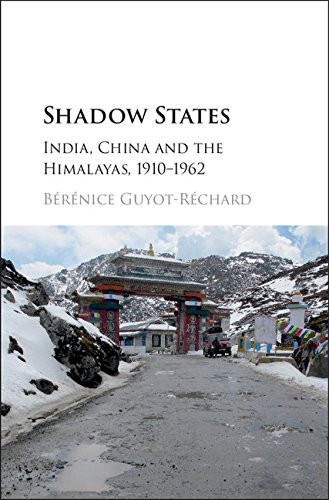
There is also a rich historiography mapping various geopolitical perspectives of the region over the last fifty or sixty years which is worth surveying in greater depth too. Owen Lattimore’s Inner Asian Frontiers remains an influential work, having lit the way when it was first published in 1940. Alistair Lamb’s several highly notable works, along with Dorothy Woodman’s Himalayan Frontiers (1969), and Alex McKay’s Tibet and the British Raj (1997), seek to triangulate the rivalries between British-India, Russia, and China, laying down the more recent historical background to current geopolitical disputes, problems rooted in the colonial era which remain as areas of on-going contestation, particularly along the borders between China and India, today. A topic which Bérénice Guyot-Réchard’s more recent Shadow States: India, China and the Himalayas, 1910–1962 (2016) re-examines – a book which, having heard Bérénice talking on this subject, sits high up on my current wish list of books ‘to read.’


In many ways, in human terms, the Himalaya can be viewed as a node or a nexus point, especially in the nineteenth and early twentieth centuries. Seen as both a natural physical as well as a social and political boundary, it is a place where civilisations and empires met. But, like all boundaries and borders, despite its seemingly vast dimensions, the Himalaya was and still remains a fluid and permeable place – simultaneously constrained by its physical aspects, it channels human movement whilst conveniently shielding the accessibility it provides, making it a hard terrain to police and control. It’s often a case of geography and climate thwarting the arbitrary ‘red lines’ drawn on maps; an immovable, mountainous barrier which confounds attempts to define human jurisdictions; a place where both notional and actual delimitations – of necessity – have ebbed and flowed with the seasons, naturally moving with the earthly elements rather than in accordance with official edicts.


Harmukh Mountain, India

The Himalaya isn’t a landscape shaped by people; however hard they might strive to impose such conformities. Rather it’s a place which ultimately people mould themselves to fit into – at least, those who live there most successfully seem to have learnt how to do so – but this hasn’t yet stopped the wider human world of bureaucratically-minded nation states located along its peripheries from trying. Perhaps it is simply a case of an unstoppable (yet all too mortal) force meeting an immovable (and comparatively immortal) object, but carrying on regardless, unbowed by the futility of its own actions and endeavours in such an unforgiving and ultimately unyielding terrain. I suppose that’s one of the reasons why it captivates me. It is a vast region of both great heights and unfathomable depths. A place of great confluences and contradictions.


Gorkha Postage Stamp, 1907

The Himalaya is a region where people contend with enormous challenges. It’s a place where we can witness how geological extremes have shaped the landscape and the environment, and, in turn, where we can see how the extremes of landscape and climate have shaped human beings. In a similar manner to the way in which I am fascinated by island lives bounded by the oceans, so too I am intrigued by the ways in which mountains mould the lives of those who choose to live (and/or travel) amongst them, either by following or bisecting the parallel contour lines of their topographies.


As yet, I have only touched the outermost fringes of the Himalaya myself, when in 2010 I travelled up into the foothills of the Sino-Tibetan borderlands in Sichuan. But it was a tantalising first taste which has left me wanting to return to range even further into the more majestic heights of Tibet itself, as well as to the closely allied altitudes of neighbouring Bhutan and Nepal. On that first trip I took Michael Palin’s Himalaya (2004) as my amiable textual travelling companion, having already watched and enjoyed his series of travel programmes which the book chronicles. But, the next time I am able to venture back to this remarkable region, I know I shall be taking a heftier – but no less amenable – tome as my ‘vade mecum’: – Ed Douglas’s Himalaya: A Human History (Vintage, 2021).


This is a wonderful book. From the first page you can tell that it was written as the fruit of a lifetime’s worth of reading about, as well as travelling in, the region it describes; hence the ‘human’ element of this history is exactly that, a personal and a personable view. It is written with a lovely fluid elegance; reading its first few chapters it feels like the reader is trekking through the Himalaya with the author as their own personal guide. Ed Douglas has a beautifully well-honed style of writing which effortlessly imparts information unobtrusively alongside his own anecdotes of travel through the region, and vice versa. It’s a subtle tour de force in the craft of good writing. The kind of book which invites revisiting and sustains re-reading. It combines the best of first-hand travel writing and historical narrative in well balanced measures of each, using the lightest of touches to combine individual immediacy with the broader, big-canvas sweep of time and place – because, after all, to attempt to distil and narrate the history of such a vast region and all its different peoples, a region as old and as diverse as the Himalaya, is no mean feat.


Kathmandu, Nepal - c.1910

Clearly it is a terrain within which Douglas is comfortably at home, roaming and writing as a mountain climber himself, having first travelled to the Himalaya in 1995, he has spent much of his life writing and reflecting upon mountaineering, having edited a number of well-known climbing magazines, as well as the prestigious Alpine Journal – the invaluable archive of which I am continually raiding (it is available on-line here). Douglas’s love of Nepal shines through Himalaya: A Human History, and, in many ways, it is Nepal which acts as a pivot to his telling of the many stories which are rooted in the complex interrelations of the broader Himalayan region, a vast area which extends out as much to the Karakorum and the Kunlun as it does to the borderlands of Central Asia and the foothills of India and China, as well as high up into the heart of the Himalaya itself.


Tibet, naturally, is the other main anchor point of the book. Tibet’s apparent isolation in effect transmuting through time into a magnet attracting Western adventurers, travelling both individually and in the name of empires, seeking to bridge borders through trade and conquest, making famous names for themselves along the way. From George Bogle and Thomas Manning to Francis Younghusband, by way of various Indian ‘pundits’, as well as a wide scattering of European and American ‘plant hunters’, and a host of tenaciously persistent missionaries, outsiders were forever attempting to follow in the footsteps of local Himalayan porters and the long established postal and trade routes of caravans, hoping to reach the much fabled ‘forbidden city’ of Lhasa – historical seat of the Dalai Lamas. Douglas introduces and discusses these Western interlopers in depth, but he also balances them with an eye to the lesser-known local actors – both those in positions of power as well as those with more lowly and locally-based agency – who both helped and hindered these attempts to open up the Himalaya to the insatiable voracity of an increasingly globalising world.


Climbers ascending Chomolungma, Mount Everest

Likewise, the later chapters of Himalaya: A Human History do not shy away from contemporary issues affecting the region – from the decades of political unrest in Tibet since 1950, to the growing concerns relating to the escalating environmental degradation now being caused by the modern-day mass-tourism overload of trekkers queuing up to reach the summit of Mount Everest; as well as the fractious on-going border disputes which have dogged diplomatic relations between China and India from the colonial era right up to the present day. Douglas peoples this latter part of his narrative with his first-hand interviews with Tibetan prisoners of conscience, individuals who have devoted their lives to fighting for Human Rights at great personal cost, and with the Sherpas of Nepal, who perform a vital yet dangerous role in facilitating wealthy foreign trekkers, as well as those people (such as the journalist, Liz Hawley), who have long resided in and watched both the slow changes and the rapid transformations which have overtaken the region in recent decades. This element of contemporary reportage lends Douglas’s book a sense of journalistic immediacy which most modern history books tend to fall short on in their closing pages.


The Himalayan Blue Poppy (Meconopsis 'Slieve Donard')

Nowadays, a lot of academic attention is most frequently directed toward the strategic and geopolitical importance of the Himalaya, but taking a broader scope we see that the influence of the region permeates much deeper into the complex processes of cross-pollination within our shared world. Early on, a significant part of the outside interest in the Himalaya was rooted in botany. Economic botany was an area of scientific interest which burgeoned with Western Imperial expansion from the Eighteenth Century onwards. Botanical Gardens were set up across the British Empire and these institutions were a huge motor in driving the machinery of empire. They sponsored journeys of exploration in which botanists, as well as some very notable missionaries with penchants for plant collecting, sought out new species while studying the effects of climate, altitude, soil chemistry, etc. Collecting and cataloguing ‘herbarium’ (dried plant) specimens, surveying vast regions in order to map plant locations, enabling them to return in different seasons at different stages of growth in order to study the lifecycles of plants, as well as collecting their seeds at the most feracious moment. These seeds were sent back to the botanical gardens as well as commercial plant nurseries, who then capitalised upon them; refining and sending different strains to different parts of the globe which could in turn propagate and capitalise further from producing and selling various crops in greater quantities, or processing derivatives from their fruits, fibres, oils and sap.


Rubber and tea were, of course, perhaps the two most transformative in terms of both local ecologies and global economies, along with the cinchona plant, from which the anti-malarial quinine could be derived. Whole landscapes were biologically re-engineered as a result – both in the Himalaya, in terms of the successful introduction of tea plants from China – most notably in the hills around Darjeeling; and at home, in terms of many of the flowering plants which we now unthinkingly accept as quintessentially English – such as primulas and rhododendrons, which can be found in the gardens of ordinary terrace houses as well as those of grand stately homes across the UK. Taking the Himalayan blue poppy (meconopsis) found in the forbidding terrain of the Tsang-po River region as a motif for all of this activity, Douglas devotes a chapter to the fascinating endeavours of these so-called ‘plant hunters’, who in many ways were perhaps the individuals who most successfully managed to come to know the true essence of the Himalaya in a manner which allied both the human and the natural worlds. One of my favourite books on this topic is E.H.M. Cox’s, Plant Hunting in China: A History of Botanical Exploration in China and the Tibetan Marches (1945).


Douglas’s Himalaya: A Human History is a perfect introduction and an overview of a huge subject area – both geographically and historically – an excellent book for orientating oneself before setting off on more focussed and localised routes of enquiry. In addition to some of the titles which I have mentioned above, some admirable companion tomes to read on a regional trek of the Himalaya would have to include Sam Van Schaik’s excellent, Tibet: A History (2011), and Andrew Duff’s, Sikkim: Requiem for a Himalayan Kingdom (2015), as well as Charles Allen’s, The Prisoner of Kathmandu: Brian Hodgson in Nepal 1820-43 (2015). Travelogues still continue to be written about the region by contemporary writers too. Vikram Seth’s From Heaven Lake (1983) is one of my favourites, recounting his journey hitching rides through Xinjiang and Tibet en route home to India when he was a young student. Perhaps the best of late, though, is Colin Thubron’s highly evocative prose, retelling a very personal journey he made, following the pilgrims walking the sacred ‘Kora’ around Mount Kailas in, To A Mountain In Tibet (2011). An excellent forum for keeping up-to-date with contemporary writings upon a diverse array of topics relating to the Himalaya is via the ‘reading lists’ which are regularly collated by the website: High Peaks, Pure Earth (see here). This website is a fantastic resource which has been hugely supportive and very helpful to me in my research over the years.


Mountains are, of course, the most essential and characteristic element of the Himalaya. And mountains seem to hold a special sort of fascination, a fascination which has written itself its own special chapter in the history of exploration (as well as several chapters of Douglas’s book). The Himalaya has often been described as “the third pole.” In terms of mountaineering, the region is home to some of the world’s most legendary and much fabled peaks. Climbing mountains whether for sport or science, either individually or as a part of an expedition team, is an immensely challenging activity which requires careful planning, reconnaissance, training and organisation. It provides an elemental test of skills and wills, testing limits both physical and psychological. I’m not a mountain climber myself, but ultimately, it seems to me that the desire (or perhaps the need) to climb mountains is a siren call to the soul. It’s not always the achievement of reaching the summit which is the most important goal. But still, the lure of scaling mountain peaks, scarps, ledges and ridges is perhaps found in the fact that they are otherwise inaccessible places which inspire a unique sense of fascination and wonder quite unlike that of other remote points on the globe. 


Tenzing Norgay on the summit of Chomolungma, Mount Everest - 29 May 1953


While researching for my PhD, leafing through the Foreign Office files at the National Archives in Kew, I have often found myself inadvertently distracted into perusing the many notes and letters relating to the British expeditions to Mount Everest (Chomolungma) in the 1920s; forever fascinated by the speculation as to whether or not George Mallory and Sandy Irvine disappeared perhaps having reached the summit, or perhaps having fallen just short of it. There are many books both by and about mountaineers from Mallory and Irvine’s day to the present, one of the most recent – which I have duly added to my ‘to read’ list – is Mick Conefrey’s, The Last Great Mountain: The First Ascent of Kangchenjunga (2020). 


Nicholas Roerich - Nan Shan, Tibetan Frontier, 1936

My fascination for this region is a fascination which is shared by many and one which is unlikely to fade from prominence any time soon. Like a shimmering glimpse of Shangri-La – in many ways, though it might well be an all too predictable cliché to say it: the Himalaya is like a vast and limitless library – a geographical and historical labyrinth – both real and actual, as well as a labyrinth which has been transmuted into texts and maps, photographs and films. It is a place which once entered, enters the soul and never leaves. A region of both the earth and the mind, a region which we will never exhaust through exploration or idle dreaming.


Andrew 'Sandy' Irvine & George Mallory, 1924

 ~ * ~


Read my reviews of Science on the Roof of the World: Empire and the Remaking of the Himalaya, by Lachlan Fleetwood (Cambridge University Press, 2022) in The Alpine Journal, Vol. 126 (2022)

And of The Myth of Shangri-La: Tibet, Travel Writing and the Western Creation of Sacred Landscape, by Peter Bishop (The Athlone Press, 1989) on GoodReads

~ * ~


A Playlist of Ed Douglas's Interviews with Various Climbers

Read an extract from Himalaya: A Human History, by Ed Douglas

Ed Douglas's own Top 10 Books about the Himalaya

Ed Douglas talks to Sherpa Ang Tsering, member of the 1924 British Everest expedition

In Search of Shangri-La in a Lost Himalayan Kingdom, by Ed Douglas

Himalaya: The Human Story - The Compass: BBC World Service


High Peaks, Pure Earth - Reading Lists


Whose Himalaya Is It? - Amish Raj Mulmi
Himal SouthAsian | 01 March 2023


~ * ~

Also on ‘Waymarks’


Betrayal in the High Himalaya – Sikkim & Tibet

Retracing the Silk Road

Reviews of Some Recent Histories of Asia

Language & Landscape in West China & Tibet

Peter Hopkirk – Historian of the "Great Game"

Mountain Climbing by Mistake

'Other Everests' - A New Research Network