|
| Jama Masjid - by Yoshida Hiroshi |
The northwest region India has been
inhabited since the second millennium BC. The site of present-day Delhi first
became a major political centre under the Tomar Rajput Dynasty in 736 AD. Over
the subsequent centuries its political prominence waxed and waned until it
formally became the capital of the Mughal Empire in 1648. The Mughal city
covered an area of just over six square kilometres and was enclosed by great
walls with access through fourteen gates. The city was presided over by the Lal
Qila, meaning Red Fort, home of the Mughal Sultans; a colossal imperial palace
constructed of red sandstone, and completed in 1648, it was built overlooking a
channel of the Yamuna River. Nearby, a magnificent mosque, the Jama Masjid (its
full name being Masjid-i-Jahan-Numa, meaning ‘World-reflecting Mosque’), was
built between 1644-1656, with two minarets each 40 metres high.
 |
| Lal Qila |
Shahjahanabad, as Old Delhi was originally
called, is now a part of a much larger metropolis. The layout of New Delhi was
masterminded by British architect, Edwin Lutyens, around 1912-1913. He laid out
a monumentally ambitious new plan for the city, which was to be the new
Imperial Capital of British India. The map he drew up showed a series of wide
boulevards and connecting avenues laid out in a beguiling geometrical pattern
which aligned many of the city’s old and ancient landmarks with those of the
new Imperial capital. Many of the new monumental buildings of government he
designed managed to mix classical and oriental elements to great effect, countering
the old adage (taken from a poem penned by Rudyard Kipling) that ‘East is
East, and West is West, and never the twain shall meet.’ Construction work,
employing some 29,000 labourers, began shortly after 1912 and lasted most of
the next two decades or so, with ‘New Delhi’ officially becoming the British Imperial
Capital in 1931. Having been purposefully designed to express the colonial
might of British India it was perhaps rather ironic that less than two decades
later it was handed over to the indigenous leaders of the newly independent
Republic of India in 1947. Since then New Delhi has remained the capital of India
to this day.
 |
| Lal Qila |
 |
| Purana Qila |
My first visit to India was quite
literally a flying one – a brief stopover in Mumbai whilst on a freighter
flight en route to Hong Kong and finally Australia in 2014. We didn’t
even get off the plane. Two years later though I went to Delhi to work on an
exhibition at the National Museum. It was a manic and yet magical time. Working
long and challenging days to get the exhibition up in time for its scheduled
opening, balanced by the full use of what free time we had to see as much of
old Mughal Delhi as we possibly could. Riding on tuk tuks at the end of the day, like Roger Moore’s James Bond in Octopussy (1983), the first Bond movie I
ever saw at a cinema; racing through the teeming streets to catch an hour or
two before the sunset at Purana Qila, Humayun’s Tomb, or the Lodhi Gardens,
before going for dinner at Khan Market.
 |
| Tuk Tuk |
My guide for many of these places –
as for so much about India’s rich history – are the books of William Dalrymple.
Prior to this trip I had been blown away by the richness and enthusiasm of his highly
evocative prose when reading the remarkable, cross-cultural love story of
White
Mughals (2002), which recounts the lives of James Achilles Kirkpatrick, the
British Resident at Hyderabad, who represented the British East India company in
the late eighteenth century, and his wife, Khair-un-Nissa Begum, and what
became of their descendants. Dalrymple describes Kirkpatrick as “thoroughly
orientalised” – converting to Islam in order to marry his bride, an
exceptionally beautiful Mughal noblewoman – the book goes on to show how British
social mores and racial attitudes changed dramatically over time from the early
days of the British Empire in India to how things were towards its end. What
begins as transcultural assimilation, balancing East and West, eventually ends
in the snobbish, racial divisions of social hierarchies and colonial humiliations
which sparked the bloody uprisings of 1857, which Dalrymple has chronicled in
stark detail in his book,
The Last Mughal (2006).

On this trip though, I
took an earlier book of his –
The City of Djinns (1994). This book is
far more personal than his later works of history, it deftly mixes anecdotal travelogue
and historical curiosity into an almost novelistic narrative. The book is filled
with characters, such as his endearing Sikh landlady, comical taxi drivers, languid
yet absurdly bureaucratic government officials, and old-colonial British expats.
Dalrymple explores the city he has fallen in love with through a remarkably engaged
sense of awareness; his pen is simultaneously awed by Delhi’s deep history and
respectful of its highly spiritual culture, yet it is also leavened by the amusing
absurdities of India’s very distinctive and occasionally peculiar outlook on
life in general. In this idiosyncratic manner Dalrymple both is and isn’t
writing as an outsider. His forebears were active participants in the former colonial
administration of India – he is a relative of Alexander Dalrymple (1737-1808),
who served as Chief Hydrographer to both the East India Company and the British
Navy. Hence one assumes his deep interest in India is rooted in a long
ancestral affiliation to it. The book ends though with an analytical eye
focussed on the more recent past and speculation about the future; drawing a rather
sobering parallel between the uprising of 1857 and the bloody feuds reawakened in
the cultural clashes which ensued during the riots that followed on from the assassination
of Indira Gandhi, India’s first and (to date) only female Prime Minister, in
1984. India is a land of many passions and Dalrymple is infectiously passionate
in his writings about it. Reading any of his books is a real joy, especially if
you are a lover of travel and history books written in gorgeously lyrical language,
in this respect he is a prose stylist
par excellence.

 |
| Purana Qila |
Purana Qila, meaning Old Fort, is
one of Delhi’s most ancient sites and is commonly held to have been built on
the site of Indraprastha, the capital of the kingdoms of the Pandavas from the Mahabharata.
The present structure originates from the time of the second Mughal emperor,
Humayun, but its construction was completed by his rival, the founder of the
Suri Dynasty, Sher Shah Suri in the mid-1500s. The Fort is today the site of a lovely
garden, the only structures remaining within its walls are the Qila-i-Kuhna
Masjid, a mosque built by Sher Shah, and an octagonal building which served as
Humayun’s library and observatory. It’s said that Humayun died as the result
falling down the library’s steps whilst hurrying to answer the call to prayer.
 |
| Humayun's Mausoleum |

Humayun’s tomb is a magnificent
example of Mughal architecture. Built of red sandstone it gives off a lovely
warm terracotta-like colour in the bright sunshine. In its design the form and
shape of the later, and much better known, Taj Mahal in Agra can clearly be
seen. Likewise, similar to the Taj Mahal, the surrounding gardens are laid out
in the
charbagh manner, in which four
water channels divide the grounds into four areas. The main tomb building sits
atop a vast platform. The small arches which line this platform are entrances
to the tombs of lesser royals. An octagonal chamber in the main building above
contains the final resting place of Humayun himself, with close family and
attendants buried in the rooms to each side. The 38 metre high dome was the
first of its kind, built in this distinctive onion shape, in India. The building
works, which took place over nine years, were watched over by Humayun’s second
wife, Haji Begum, who lived on the site for the entire period until the tomb
complex was completed in 1570.
 |
| Humayun's Mausoleum |
 |
| Isa Khan's Tomb |
Nearby, in a compound adjoining the
Humayun complex, is the smaller yet substantial tomb of Isa Khan, built in 1547.
Isa Khan Niazi was a noble who served in the Court of Sher Shah. His tomb is octagonal,
designed in the Lodhi-style. Much of its original tilework has disappeared
making it look rather weather-worn, a more modest testament to the ages perhaps
when compared to the imposing tomb of his more powerful neighbour. Isa Khan’s
mausoleum complex also includes a mosque, the architecture of which is rather reminiscent
of the one found in the Purana Qila. Both the tombs of Humayun and Isa Khan are
very pleasant places to wander. It was interesting to note here, as at Purana
Qila, how some visitors, notably Muslims, removed their shoes or sandals before
entering the tombs and the now defunct mosque buildings as a mark of respect.
 |
| The Mosque by Isa Khan's Tomb |
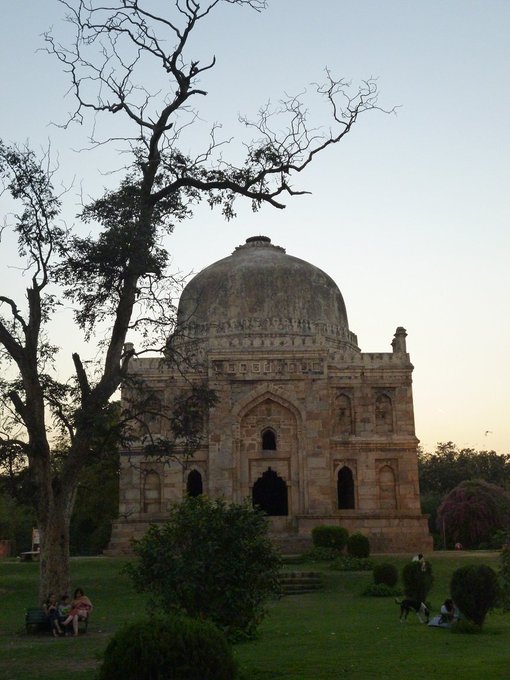
More tombs in the Lodhi-style can
be found in the nearby Lodhi Gardens, a popular spot for local Delhi folk to
walk in the cooler morning or evening air. Here the tombs of Mohammed Shah and Sikander
Lodhi, local rulers whose Sayyid and Lodhi dynasties date back to the fifteenth
century. Two other buildings, the Shisha Gumbad and Bara Gumbad, respectively
meaning the ’glazed dome’ and the ‘big dome’ are more ambiguous. The first contains
tombs of other unidentified nobles and important persons the Lodhi era, whereas
no tombstones have ever been found in the second, hence the purpose of its
construction is now unknown. Again, Lodhi Gardens is another wonderfully evocative
place to wander round at the end of the day as the sun sets.
 |
| Sikander Lodhi's Tomb, Lodhi Gardens |

There were two places I didn’t
have enough time to see during my stay in Delhi. Firstly, the Qutb Minar –
dating back to 1199, with its distinctive tower and the renowned ‘iron pillar’
which was made in the fourth century AD, the metallurgical make-up of which
somehow (some say, magically) keeps it from rusting even though it stands open
to the elements. And second, the Gandhi Smirti, where Mahatma Gandhi was shot
in 1948, as well as the Gandhi Memorial Museum. When I was about 13 or 14 we
watched the famous Gandhi biopic (directed
by Richard Attenborough, in 1982) at school, which moved me greatly –
particularly the scene depicting the Amiritsar Massacre. It kindled in me a
deep interest in M. K. Gandhi’s life, such that I immediately bought and read
his autobiography, My Experiments with
Truth. Written in the 1920s and first translated into English in 1940, it
tells the story of Gandhi’s upbringing, how he studied in London and became a
lawyer, and how his experiences of racial discrimination, particularly in South
Africa, along with his deeply complex spiritual leanings, shaped his character
and culminated in his becoming the leader of India’s independence movement and his
resistance strategy of mass civil disobedience through peaceful
non-cooperation. Every day on our way to and from our hotel to the National
Museum and back we passed the Gandhi Smirti, but always after it had closed or
before it opened. If ever I go back to Delhi it’s a place I’d very much like to
see for myself.
 |
| Lal Qila, the Red Fort |
 |
| Jama Masjid |
 |
| Jama Masjid |
 |
| Purana Qila |
 |
| Humayun's Mausoleum |
 |
| Bara Gumbad, Lodhi Gardens |
 |
| Shisha Gumbad, Lodhi Gardens |
 |
| Connaught Place |
Also on 'Waymarks'




 On this trip though, I
took an earlier book of his – The City of Djinns (1994). This book is
far more personal than his later works of history, it deftly mixes anecdotal travelogue
and historical curiosity into an almost novelistic narrative. The book is filled
with characters, such as his endearing Sikh landlady, comical taxi drivers, languid
yet absurdly bureaucratic government officials, and old-colonial British expats.
Dalrymple explores the city he has fallen in love with through a remarkably engaged
sense of awareness; his pen is simultaneously awed by Delhi’s deep history and
respectful of its highly spiritual culture, yet it is also leavened by the amusing
absurdities of India’s very distinctive and occasionally peculiar outlook on
life in general. In this idiosyncratic manner Dalrymple both is and isn’t
writing as an outsider. His forebears were active participants in the former colonial
administration of India – he is a relative of Alexander Dalrymple (1737-1808),
who served as Chief Hydrographer to both the East India Company and the British
Navy. Hence one assumes his deep interest in India is rooted in a long
ancestral affiliation to it. The book ends though with an analytical eye
focussed on the more recent past and speculation about the future; drawing a rather
sobering parallel between the uprising of 1857 and the bloody feuds reawakened in
the cultural clashes which ensued during the riots that followed on from the assassination
of Indira Gandhi, India’s first and (to date) only female Prime Minister, in
1984. India is a land of many passions and Dalrymple is infectiously passionate
in his writings about it. Reading any of his books is a real joy, especially if
you are a lover of travel and history books written in gorgeously lyrical language,
in this respect he is a prose stylist par excellence.


 Humayun’s tomb is a magnificent
example of Mughal architecture. Built of red sandstone it gives off a lovely
warm terracotta-like colour in the bright sunshine. In its design the form and
shape of the later, and much better known, Taj Mahal in Agra can clearly be
seen. Likewise, similar to the Taj Mahal, the surrounding gardens are laid out
in the charbagh manner, in which four
water channels divide the grounds into four areas. The main tomb building sits
atop a vast platform. The small arches which line this platform are entrances
to the tombs of lesser royals. An octagonal chamber in the main building above
contains the final resting place of Humayun himself, with close family and
attendants buried in the rooms to each side. The 38 metre high dome was the
first of its kind, built in this distinctive onion shape, in India. The building
works, which took place over nine years, were watched over by Humayun’s second
wife, Haji Begum, who lived on the site for the entire period until the tomb
complex was completed in 1570.