20 February 2023

Abney Park, Stoke Newington - A 'Memento Mori'


Clissold Park

Yesterday I took a break from my academic writing projects, and, making the most of the wonderfully clement weather, I hopped on the Number 73 bus, heading to Stoke Newington. I lived in ‘Stokey’ for five years from 1997, and I think this was my first visit back there since at least 2004. All-in-all, it really was a perfect day. I spent a nostalgic afternoon wandering around Clissold Park, where I used to like sitting on one of the benches by the ponds, reading in the early summer evenings after work. I was glad to see the Public Library is still there, but most of the shops and restaurants along Church Street have changed since my day; except for one or two, like Church Street Bookshop, Rasa, The Blue Legume, and, happily, the wonderful old pubs.


A Perfect Day - Stoke Newington - 1998


Stoke Newington seemed a lot busier than I generally recalled it, although this was probably due to the wonderful weather. A not too crisp, cold clear blue sky made it feel a lot like Spring had truly begun at last. I noticed crops of crocuses and snowdrops were out in many places, adding a welcome dash of colour beneath the still bare branches overhead. Claustrophobically shying away from the slow foot-shuffling crowds, I ducked into Abney Park Cemetery, and proceeded to get happily lost in the verdant woodland, drinking in that dank fecundity of the air with the ground softly springy underfoot. There seems to be a lot of restoration work going on around the entrances on both Church Street and the High Street, plus the long derelict, pigeon-haunted chapel in the centre of the cemetery appears to be in the process of being exhumed from years of ruin and neglect.


Church Street, Public Library

After emerging from the pleasant quiet of this labyrinthine Gothic woodland, I wandered up Cazenove Road to Springfield Park, with its wonderfully dizzying vista looking down to the River Lea where it meanders lazily alongside Walthamstow Marshes. Crossing the bridge to Springfield Marina, I found multitudes of people once more. All of them, out for a stroll like me. Ambling along the gravel track, passing under the ‘Avro Arches’, heading past flowering hawthorn bushes towards the next footbridge where I crossed and doubled-back along the opposite shore. Passing the many-patroned Anchor and Hope pub, then climbing back up the steeply raked hill to the pond at the top of Springfield Park once again, before making my way back down to Stoke Newington. Here I idly wandered around some more. Retracing my former well-trodden and much familiar routes through the backstreets, passing the house where Joseph Conrad once lived on Dynevor Road when he was lodging in London between ships, and where it is said he later took inspiration for the characters of the Verloc’s in his novel, The Secret Agent (1907), from his landlord and landlady.


High Street

Back on the High Street, I was taken aback to see the road had been closed off completely. It was filled with a monstrously huge structure made from scaffolding. I later found out that back in January part of one of the old Victorian terraces of shops had collapsed into the street. Thankfully, no one was hurt at the time, but everyone living and working there has since had to be rehoused, or have had their businesses suspended, while Hackney Council attempts to shore up the building. I used to live on the High Street, just next to the Police Station – opposite the derelict Vogue Continental Cinema, and so I knew and was known by several of the shopkeepers; but here again, most of the shops and restaurants from my day have long since disappeared, as has the building in which I used to live. Looking into the whitewashed window of the launderette, where I often spent my Saturday mornings, I read a notice pinned to the door announcing its final closure in June 2022, thanking its many customers over the years. It had outlasted my patronage by twenty years. I used to love its smell of soap powder and warm-linted tumble dryers. The lady who used to run it had a comfortingly warm smile too. There was a friendly camaraderie among the many familiar faces who called the High Street home back then. I remember one time, after a power cut one evening, an old boy who came into the little supermarket next to the Methodist Church had everyone in stitches; telling everyone how he had been sitting on the toilet when the lights went out, and how for the best part of an hour he’d had to sit there with his “arse getting cold without even a cigarette lighter” to help him pass the time in reading a newspaper until the lights eventually came back on!


The Old Police Station

Looking back, those five years seemed to be filled with many magical memories such as the ones which were now coming flooding back to me. Wandering around those streets, it was a wonderfully nostalgic way to wile away an afternoon. But my connection to this place goes deeper than my five years living above a shop on the High Street. More than a hundred years ago, many of my forbears on both sides of my family lived in Stoke Newington and Green Lanes too. One of my great grandfathers worked for the Metropolitan Water Board, and my great grandmother died while they were living in Stoke Newington. I was reminded of this whilst ambling around Abney Park Cemetery. I’ve not been able to find out where she was buried, and I have always wondered if she might have a grave somewhere hereabouts. Abney Park is crammed with gravestones, each one representing the memories of numerous lives lived only to be forgotten. Reclaimed by the greenery in the sacred grove of one of London’s “magnificent seven” Victorian cemeteries. I’d often got lost in here back in the days when I called Stoke Newington home, and today was no different. Just when I realised I’d lost my bearings, my eye was caught by a name on one of the tombstones nearby. It wasn’t the name of my great grandmother, but it was a name which was familiar to me. No longer a common name today, it was shared by an old lady whom I’d known when I was young. We used to be bellringers together at the church back in the part of northwest London where I grew up. As I read the inscription on this headstone, I realised that the following day – today (20 February 2023) – would be the centenary of the death of the woman laid to rest here.


Abney Park Chapel

There are many famous people buried in Abney Park, but there are many more besides who were ordinary folk much like you and me; known only to those who knew and loved them in their day. Eleanor Rigby-like, I wondered who was this particular woman? – There was no indication of how old she was when she died, nor if she and her husband had any children, though it did record the fact that he survived her by several decades and was eventually buried with her at the age of 72. ‘Reunited’ as his inscription said. There was something about the name, the style of the leaded-lettering, and the serendipity of my happening upon her grave just one day short of a century since she’d died. I wondered if anyone might come and visit them both tomorrow, but the grave didn’t look like it had been tended in a very long time. And so, thinking about this – and about my own great grandmother who had died locally – whilst I wandered around Stoke Newington, reevoking memories of my own times gone-by living just a few streets away, I later penned a poem to this lady whom I did not know as small a centennial remembrance.


MEMENTO MORI


‘Dearly Belov’d’ of husband’s memory;
She died more than thirty years before he.
Laid to rest in Abney’s cemetery,
Where I did come upon her grave by chance.
My eye happened to catch her name askance,
Her headstone hugged on one side by a tree;
On the other, a tendril of ivy
Clung to the green-shaded slab; one among
All the many whose names are now unsung.
All except for William’s dearest one,
Whom, here today, happily I did see,
Close to the hundredth anniversary
Of her death: tomorrow as it will be.
Time’s passing, a century less one day,
This headstone assures tomorrow Cissie
Will be remembered now at least by me.
In elegant script, her memorial
Merging with Abney’s green arboreal;
‘Ici Repose’ since nineteen twenty-three,
I write this verse in remembrance of one
Who lived, was loved, and yet is now long gone:
Sadly missed, – Cecily Mary Picton,
A name unknown, and yet unforgotten.


Abney Park Cemetery, Stoke Newington – 19th February 2023.


Abney Park Cemetery


You can view a photo of Cissie’s headstone taken in 2007 here on Flickr.


And you can listen to a fascinating talk about the forgotten poets who are buried in Abney Park Cemetery here on Abney Park’s equally fascinating website.


Likewise, there’s a great video diary following John Rogers on one of his walks around several of the areas I’ve mentioned above, which you can watch on his YouTube Channel here. I’m a big fan of John’s rural and urban ‘psychogeographical’ videos, I highly recommend them.


Amir Dotan's Stoke Newington History Website, also highly recommended.
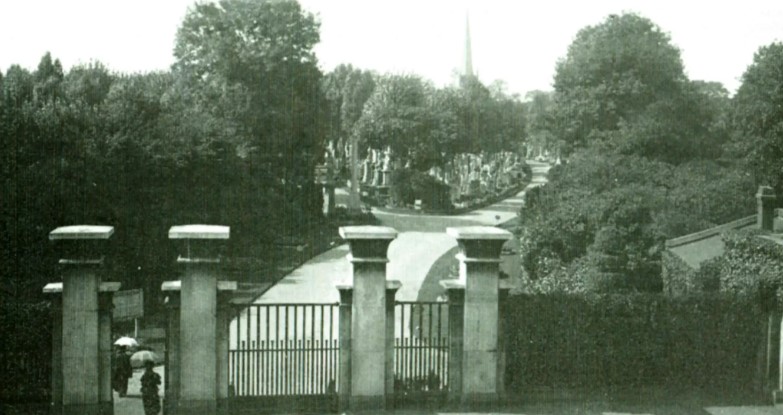


High Street Entrance to Abney Park Cemetery


Also on ‘Waymarks’:


Family Trees – Retracing My East End Roots


“Here Lies One Whose Name is Writ in Water”


Visiting Joseph Conrad’s Grave – Canterbury


Albion Road

1 December 2022

Colin Thubron - Time Seen As A Road ... Or A River


Colin Thubron

There is something mellifluously melancholy in the tone of Colin Thubron’s travel books. He is a wonderful writer, a genuine poet in prose. Curiously, his writing manages to be both orientated entirely inward, whilst also being outward-looking at the same time. It really is quite remarkable. And it is perhaps this paradox which is what makes his travel books such satisfying reading. As travel writers go, he is perhaps the travel writer’s paragon – the kind of travel writer whom most would-be travel writers might aspire to emulate. Oddly shy and unassuming, and yet open to experiences and interactions. He frequently ends up chatting to all sorts of ordinary and unusual people, tagging along with them, sharing a train compartment, or being invited into their homes and their lives; drifting along, progressing on his way until something or nothing happens. Either way the outcome is equally mesmerising. He does bathos and pathos with aplomb.


There are moments of drama too, usually rendered with beautiful understatement, such as when the police turn up and haul him off for questioning, as they frequently seem to do. This is usually because Colin is drawn to the parts of the world which aren’t exactly used to receiving visiting tourists, at least not those of a lone hapless, wandering Englishman-type, such as he appears to be. Naturally they suspect he must be up to no good; some sort of criminal or clandestine activity, possibly spying? – But Colin is wonderfully ‘old school’, as some might say. He tends to eschew modern technology, and he rarely travels with a camera. Only his spidery and illegible handwriting in his notebooks inadvertently lends him a taint of suspicion, but as soon as he begins to translate his scribbled notes for his interrogator, the police quickly come to realise Thubron is indeed a wandering poet, waxing lyrical about landscapes they find mundane but which he sees as sublime.


I came to Colin Thubron’s travel books quite late, and I really can’t understand how or why I had not come across him before. It was an interview he gave on BBC Radio 4, back in early 2007, when he was promoting his then recently published book, Shadow of the Silk Road. I was entranced by his evocative descriptions of travelling through landscapes and reflecting upon the history of places which had long held a deep and abiding fascination for me. And it was later on, in the summer of that same year, when I was travelling through China, that I began reading Shadow of the Silk Road for myself. I realised it was kind of oddly serendipitous to begin reading the book there in Xi’an, where the book itself begins; but, unlike Colin, the journey which I was about to undertake would lead in the opposite direction, heading east, overland to Beijing. I had gone there to escort a cohort of terracotta warriors across China and onwards to London for a landmark exhibition at the British Museum, entitled ‘The First Emperor.’ Whereas the Shadow of the Silk Road recounts Thubron’s 7000-mile journey heading west, travelling from China through Central Asia and Afghanistan to the Islamic countries of the Middle East and on to the Mediterranean. A route along which he is haunted by the persona of another traveller, talking to him across the vast Steppe-like expanse of time in the bygone centuries-old voice of a Sogdian camel driver travelling with one of the old merchant caravans which used to cross the deserts and the high plateaus of the network of routes which once criss-crossed that region, now collectively and somewhat Romantically known as ‘the Silk Road.’


Thubron has often spoken of the solitary traveller as being two people travelling in tandem. There is the person who is actually doing the travelling – clocking the miles, suffering the pains and anxieties, marvelling at the wonders both large and small which befall him along the way; but then there is also the person, the travel writer side of himself, who (in a sense) sits upon his shoulder throughout the journey – noting all the things which will make ‘good copy’ for a travel book, and often consoling him with that fact when he finds himself in situations of adversity, such as when he gets questioned by suspicious police officers. The greatest fear for a travel writer, he has said, is that nothing will happen at all.


In reading Thubron’s books the reader experiences the world with him. He has such a wonderfully deft way with words and emotions that while his books are deeply personal documents, they also seem somehow oddly divested from him as their author. When he published To A Mountain in Tibet in 2011, I heard him joke (again on the radio) that people had sometimes complained that he didn’t put more of himself into his books, but that with this one, they might now wish he’d done the opposite, because To A Mountain in Tibet is a deeply personal book. It is a book about a journey he made on foot, a pilgrimage of sorts, making the kora around Mount Kailash – a sacred mountain which is central to the cosmology of several major religions, but at its core it is also a book which deals with the universally felt subject of grief. People often speak of life as being a journey or of time being seen as a road, and travelling – escaping the everyday of our own worlds and all that is familiar to us by going somewhere far away and utterly different in terms of society, culture, language, religion – this kind of travelling can be a way of reflecting upon ourselves, who we are, where we come from, and how we fit into the wider aspect of a globalised world. Travel is thereby seen as a way of breaking down boundaries, crossing borders and bridging divides which might otherwise have remained unseen or worse, wilfully overlooked. In that sense travel is not about seeking escape, but rather of seeking to find something extra. Redefining the self and our home in sympathy as well as in contrast to that which we might simply assume to be ‘other’ is what the real goal of most travellers tends to be. I read To A Mountain in Tibet at a time of similar although slightly different emotional upheaval in my life, and so the book certainly spoke to me on more than one level, as it was perhaps intended to do. It was a reminder to me that both travel and the closely allied activities of reading and writing can be a balm to the soul.


Thubron’s latest book, The Amur River: Between Russia and China (2021) is equally sublime. It is certainly one of Thubron’s best travel books, in my opinion. In this book he travels the length of the Amur from its source in Mongolia to the coast, opposite the northern part of Sakhalin Island, where the river emerges between the Sea of Japan and the Okhotsk Sea. It’s an enormous watercourse, undammed and largely unknown in comparison to its more famous cousins, such as the Amazon, the Danube, or the Nile. Along the way he alternates between the river’s northern and southern shores, between Russia and China. The Amur forms a boundary which both divides and connects these two geographically huge nations, each vastly different in culture and outlook, which meet along one section of its banks. The huge disparities in terms of populations and local economies makes the locals on either side of the river uneasy neighbours. As with all of Thubron’s travel books, he seeks out insights into the histories and cultures, both national and local, of the people whom he meets along the way. He relates the snippets of themselves and their lives as they reveal their personal stories to him. He is particularly interested in the original indigenous customs, seeking out the traces of shamans and their animistic beliefs which seem to linger, often half-forgotten, having almost been entirely obliterated by centuries of incomers hailing from the larger surrounding polities and their overwhelming tides of political and religious ideologies, seeking to modernise, revolutionise or capitalise upon an uncompromising land and an unruly watercourse which ultimately always seems to defeat them. 


One gets the sense from reading Thubron that the further he travels along the Amur the more remote it becomes, even from itself. It feels like a place oddly forgotten and removed from the wider world, even though the myriad worlds of its own which it forms along its course all seem somehow larger than life as it is lived in other parts of our modern and globally interconnected world. Reflecting upon this, he quotes one of my favourite writers: “In a poignant passage of Andrei Makine’s ‘Once Upon the River Love’, his protagonist speculates that you could spend your life on the remote Amur and never discover whether you were ugly or beautiful, or understand the sensual topography of another human body. ‘Love, too, did not easily take root in this austere county …’ (p.261-262)


I’ve often wondered about the Amur. Firstly, having come across it in other books I’ve read, particularly about nineteenth-century Russian explorers such as Nikolay Przhevalsky, who explored the Ussuri region, and Nikolay Muravyov-Amursky, who led the expansion of the Russian Empire to the shores of the Sea of Japan. And secondly, from having glimpsed parts of it or its tributaries when flying across Siberia en route to and from Japan, looking down upon such a vast and expansive frozen landscape with real fascination. Hence, I was very keen to read Thubron’s account of his following this long-flowing riverine thread through a land I’ve only ever glimpsed and imagined from afar. A river so long it has many different names, among which it is: the Onon in Mongolia, the Heilong Jiang in China, and the Amur in Russia. 


Thubron’s journey along the river’s course was not an easy one. In Mongolia he begins his journey on horseback, but not long after he sets out his horse stumbles in the boggy ground and falls upon him which results in a couple of cracked ribs and a broken ankle – and yet Thubron, who is in his eighties, stoically soldiers on, mentally kidding himself that his ankle is merely sprained. The thought of curtailing his trip and returning home to properly convalesce is a far more painful prospect than carrying on. Thubron is a true traveller to his core. And thankfully – as he always does – Thubron shapes a journey around himself which is inimitably his own. Mastering just enough of the languages of the people he travels among before setting out – in this case Russian and Mandarin – in order to converse with them unmediated. He says he takes a year to research and prepare before embarking, and then about a year afterwards to write his journey up. Consequently, his travel books are undoubtedly on a par with, and in some cases more than equal to those who have similarly found fame in defining the genre, writer-travellers such as: Patrick Leigh Fermor, Bruce Chatwin, Wilfred Thesiger, Eric Newby, Robert Byron, Ryszard Kapuscinski, Gavin Young, Paul Theroux, Dervla Murphy, et al.


I’m not at all surprised that Thubron is drawn to the fictional works of Andrei Makine. He and Makine clearly share a common ground in their fascination for the sublime, for Russian melancholy, and for deeply profound meditations upon the slow passing of time and memory, deftly rendered with the lightest and most masterfully-understated touches of true sympathy. For me Colin Thubron’s writings represent the pinnacle of what I am seeking in a good travel book: a deeply lyrical and contemplative exploration of both place and people, a deft mixing of history, anthropology, landscape, and atmosphere, illuminated through individual insight. The best travel books in my opinion, like a river, wend a slow and unhurried way through our shared world, showing us places far beyond our own doorstep – places which we might never see or experience for ourselves; but done so through carefully considered words, words through which we might see and live vicariously. Travel writing is undoubtedly a craft of its own kind, offering the reader an escape through someone else’s eyes – wherein words can shape mellifluous memories which often remain with us long after we’ve finished our first reading of such books. The Amur River is certainly one to treasure.


Somewhere over Russia, near the Sea of Japan - 2004


~

“In the mist of early morning the far shore next day is only a sepia hairline, as though the horizon had rusted away at its edges. The river is formidable now. For over 2,500 miles it has gathered its tributaries from a basin almost the size of Mexico, until its brown flood pours northward through a channel that sometimes reaches three miles across. As our boat shudders upriver in the lightening day, the eastern shore ascends in mountain walls of pine, spruce and birch, where wisps of cloud dangle, as if from steaming jungle. Even as we speed beneath them, Sergei and Alexander go on smoking, cupping the cigarettes in their hands against the headwind, while our beer bottles dwindle alongside a bag of frozen smelts with cartoon faces.”  Colin Thubron, The Amur River (p.247-248)


Colin Thubron - Time Seen As A Road - The South Bank Show, 1992


Also on 'Waymarks'


Andrei Makine - An Homage to Lost Time

Person & Place - The Essence of Good Travel Writing

Parallax - Patrick Leigh Fermor